Is CONSPIT OVERHYPED?
ARES 20 Platinum, ARES 12, CPP EVO Pedals & Wheels Tested
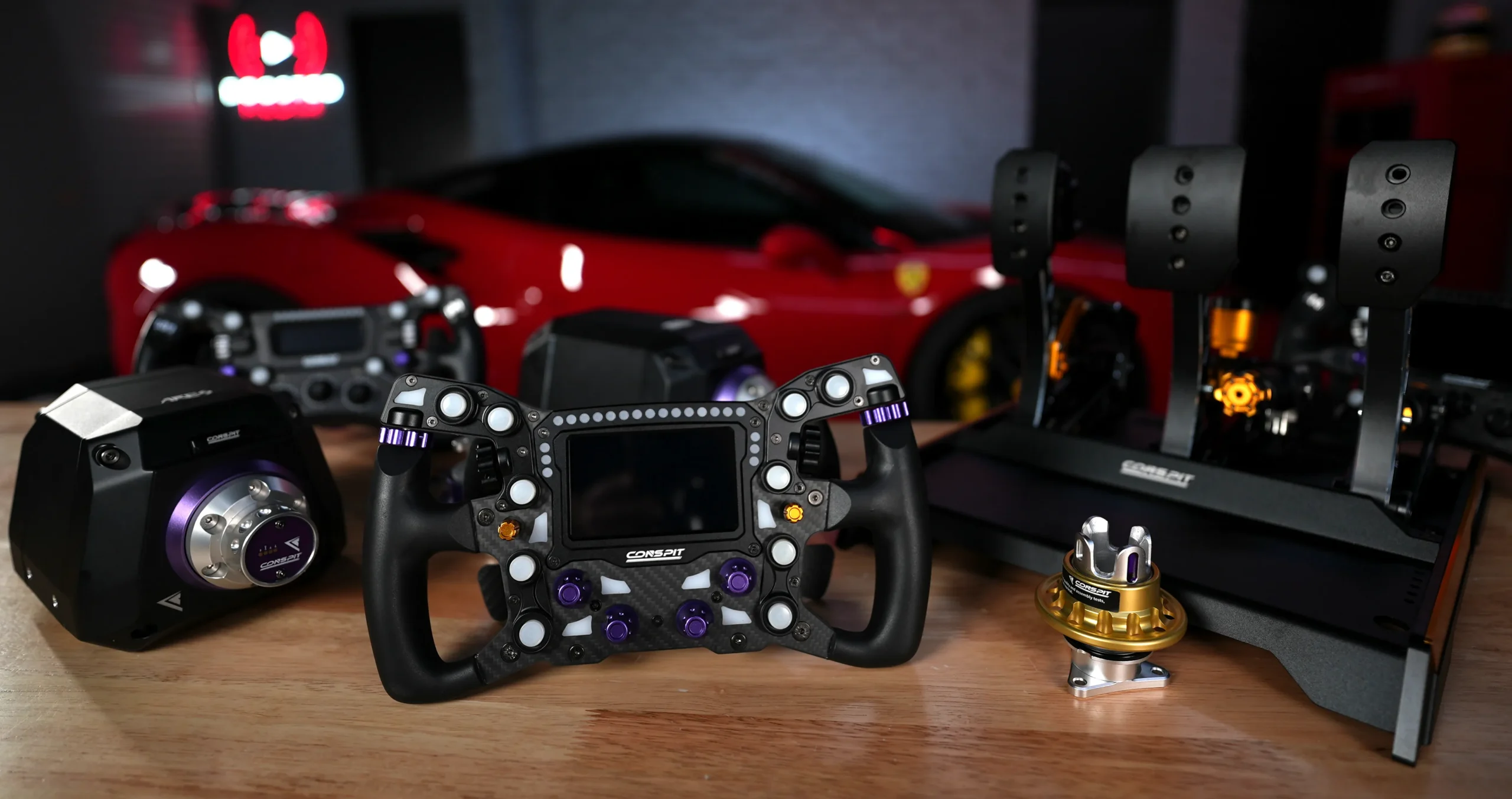
CONSPIT has exploded in popularity recently with a formula that on paper is very easy to like: premium-looking hardware, big feature lists, aggressive pricing, and an ecosystem that appears more open than some of the established alternatives.
After spending the better part of a year testing various iterations of the CONSPIT line-up, we’ve reached a point where we can give a proper view of the ecosystem as a whole while taking a close look at a broad range of gear.
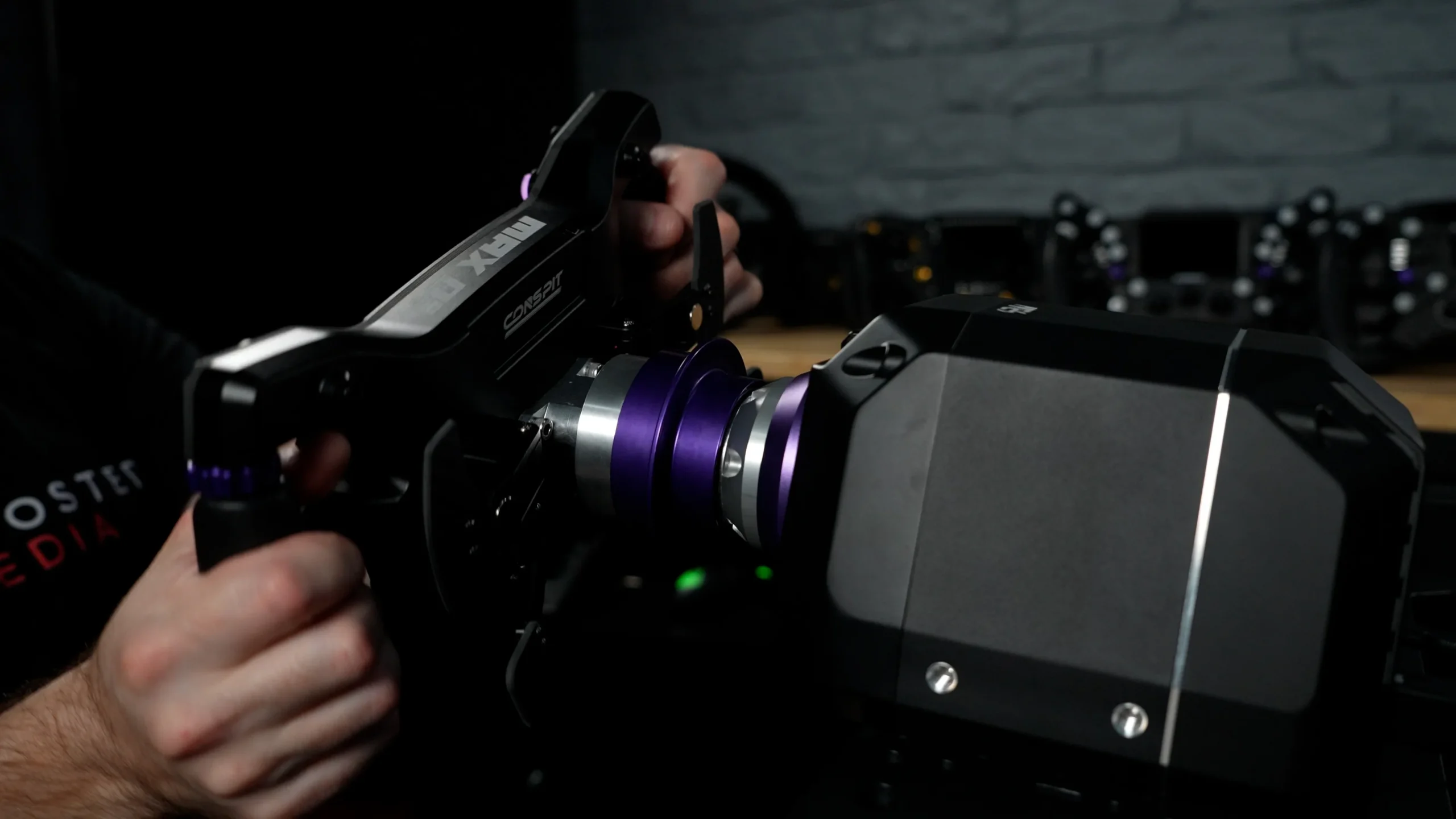
This is not a typical single-product review. Instead, this is a broader look at what CONSPIT currently offers across the main hardware categories: the ARES 20 Platinum and ARES 12 wheelbases, the CPP EVO pedals, a selection of steering wheels, the quick release systems, and the wider ownership experience through Conspit Link 2.0.
There is clearly a lot of potential here, and there are some genuinely good products in the range. But there are also still enough issues around refinement, consistency and execution that it does not yet feel like a fully mature ecosystem.
So let’s take a deep dive into the CONSPIT ecosystem to find out where the brand gets it right, where it still falls short, where the value really lies, and which parts of the range are actually worth considering for your sim rig.
CONSPIT Direct Drive Wheelbase Ratings
If our reviews have helped you decide what the best sim racing gear is for you, please consider using the links on this page to make your purchase. By doing so you’ll be supporting Boosted Media at no additional cost to you! This option is available for a huge range of Sim Racing gear.


CONSPIT Pricing and Product Lineup
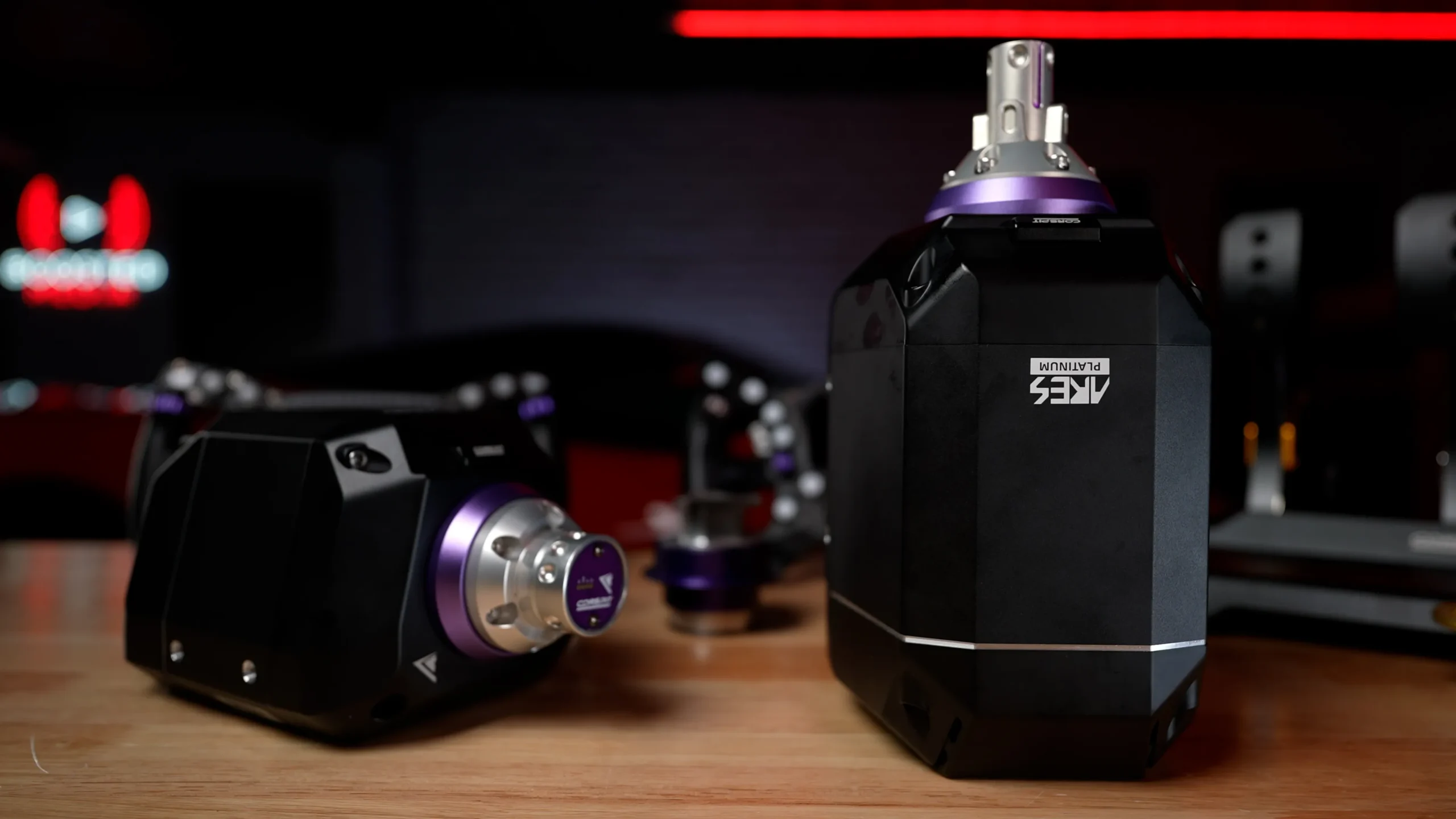
At the top of the wheelbase range is the ARES 20 Platinum, priced at US$749 for 20Nm of torque. Below that sits the ARES 12 at US$539 for 12Nm, while the ARES APEX — which we have not tested — is an 8Nm base at US$419.
On the pedal side, the CPP EVO sits at the top of the stack at US$799 for the 3-pedal set with a hydraulic brake and haptic motors, or US$699 for the 2-pedal set. The CPP Lite is priced at US$640 for the 3-pedal set or US$536 for the 2-pedal set, and also features a hydraulic brake and haptic motors, although it is rated at roughly half the braking force of the CPP EVO. The CPP APEX 2-pedal set at US$319 is CONSPIT’s cheapest pedal option and still uses a hydraulic brake. At the time of writing, we have only tested the CPP EVO pedals.
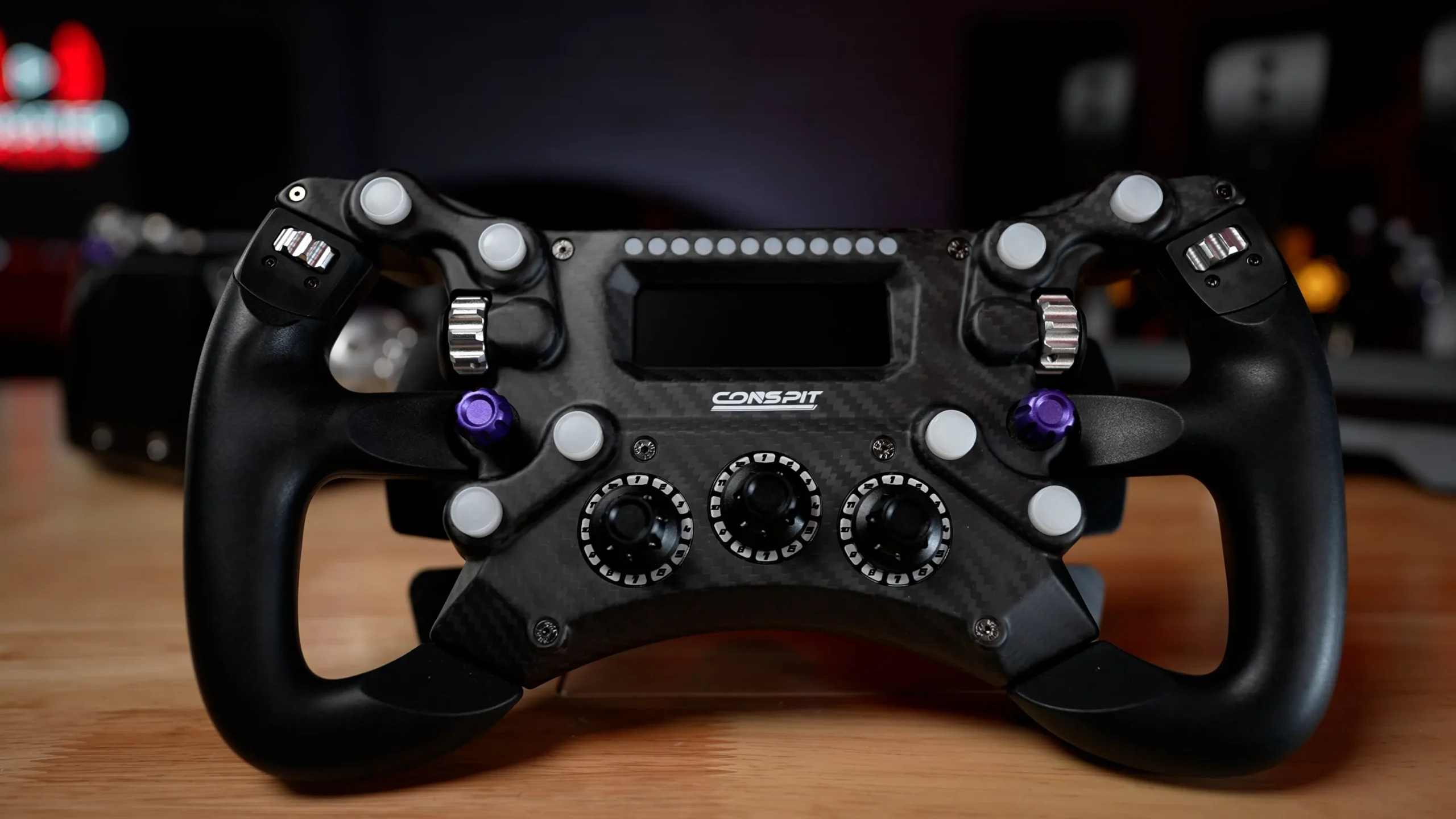
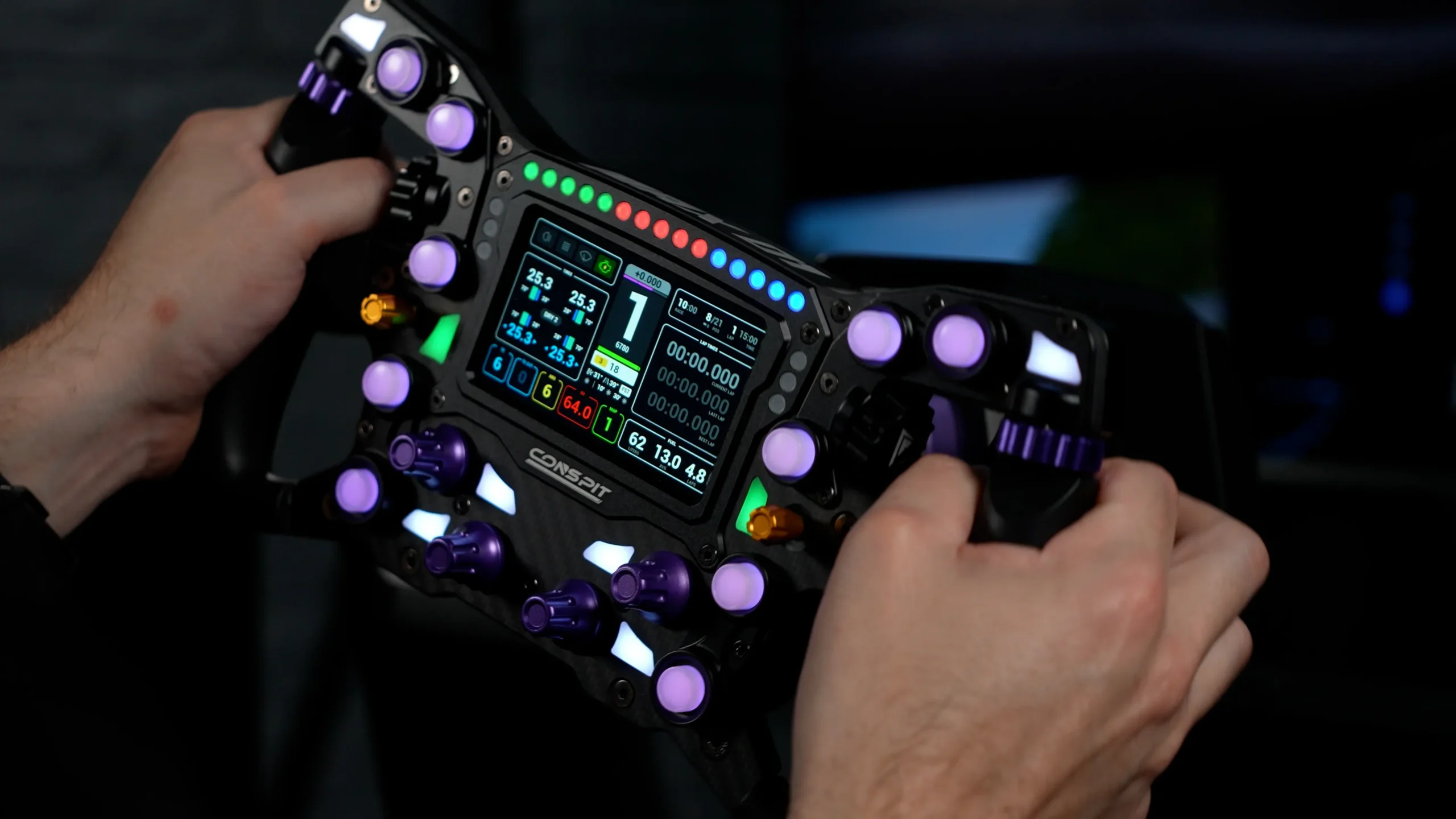
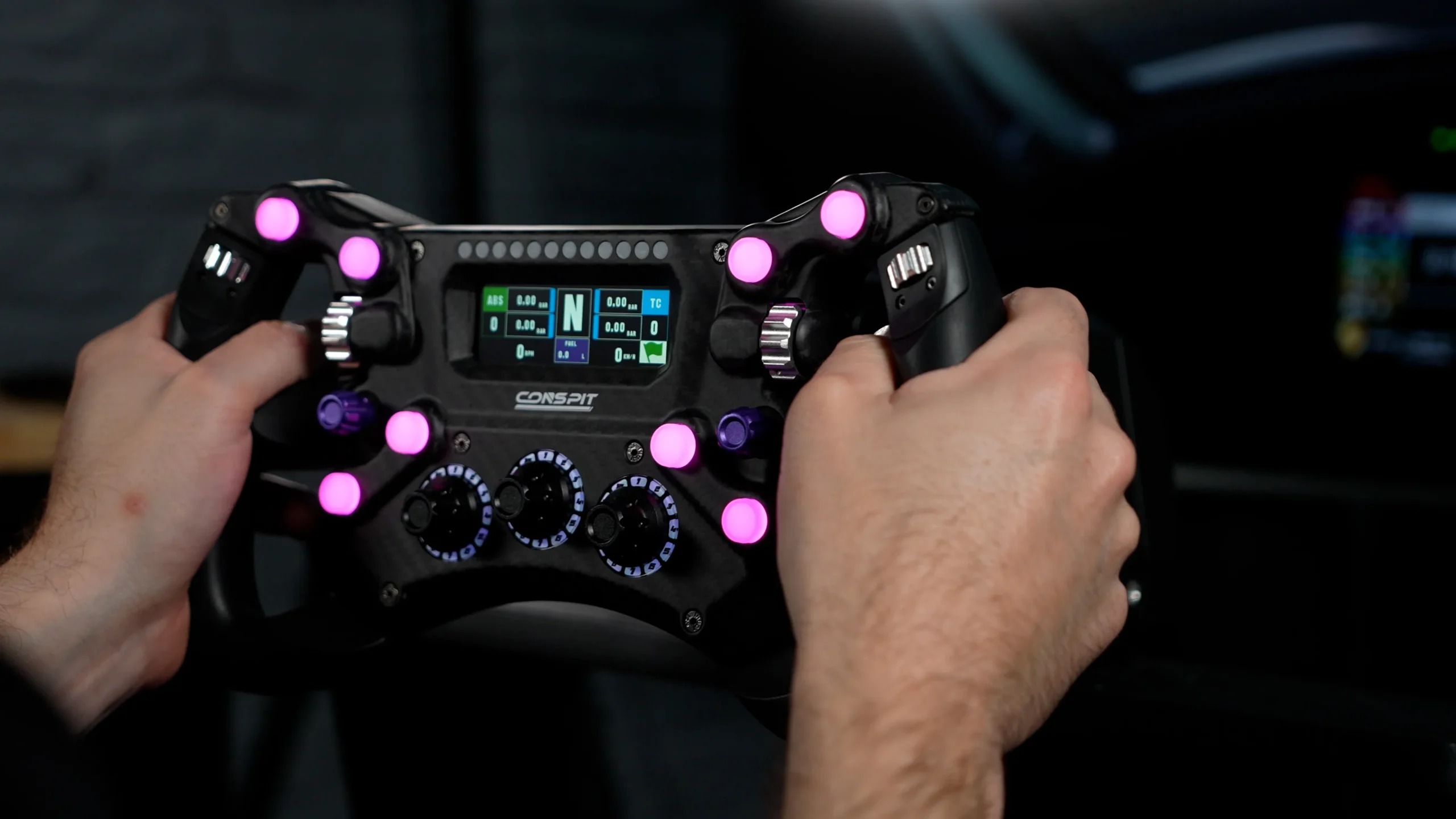
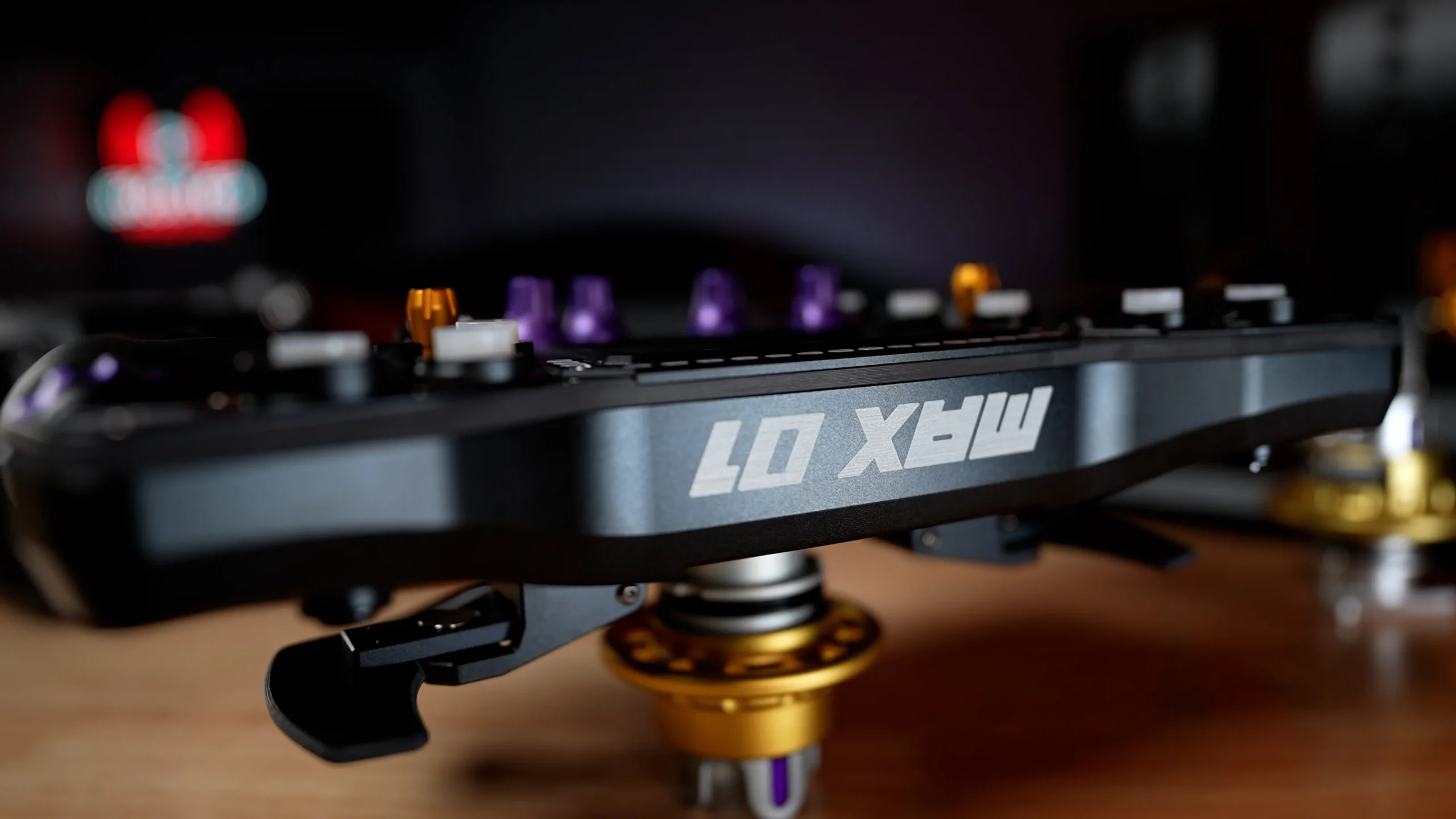
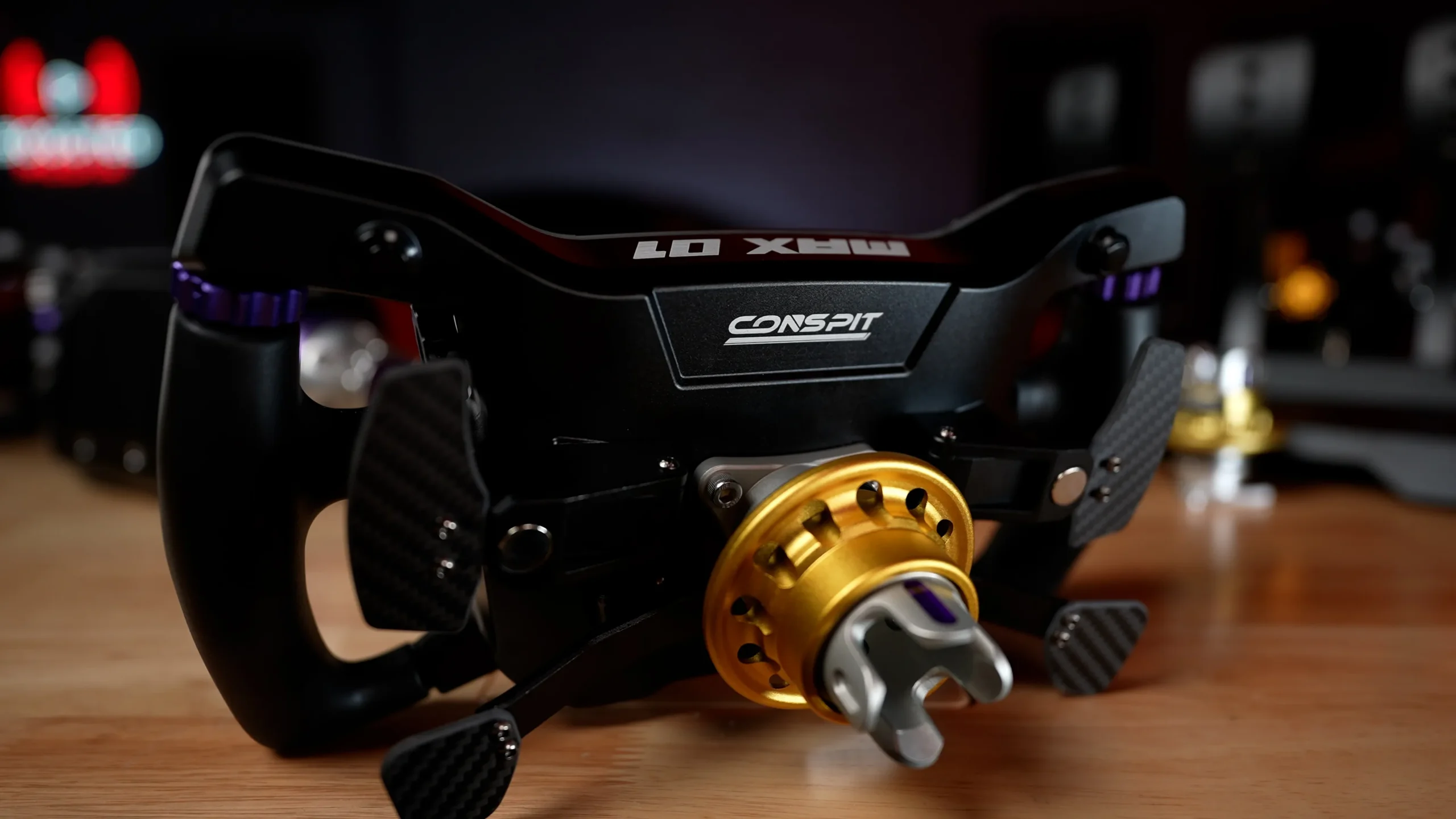
The steering wheel lineup includes the three wheels we have tested: the MAX 01 at US$804, the 290 GP at US$734, and the 300 GT at US$474. The flagship CONSPIT wheel is the PW1, priced at US$1,799, which we are yet to test.
The overall pattern is pretty clear. CONSPIT is trying to give buyers a lot of visual appeal and a lot of advanced features for the money. These products are by no means cheap, but they do come in at a more accessible price point than many alternatives offering similar feature sets. That is a big part of why the brand has attracted so much attention.
CONSPIT Ecosystem overview
One of the more appealing things about CONSPIT is that it does not appear to be trying to trap buyers inside a tightly closed ecosystem.
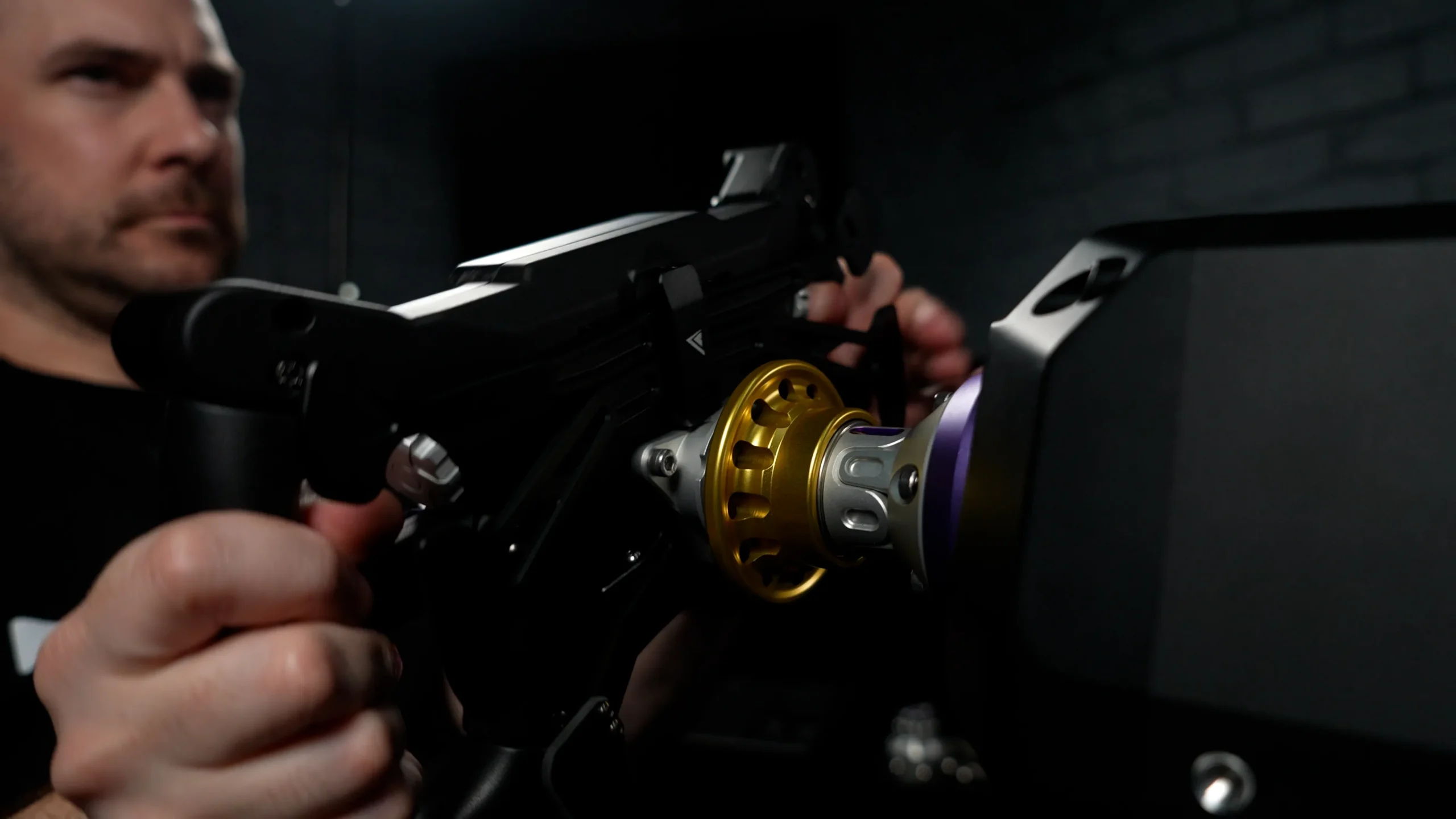
The wheelbases allow broader wheel compatibility, and CONSPIT offers adapters and passthrough solutions that make it easier to run third-party gear with USB passthrough. That matters, because some ecosystems become much more expensive than they first appear once you start adding quick releases, wheel-side adapters and compatibility parts.
That openness is one of the stronger parts of the CONSPIT pitch. The ecosystem looks flexible, and the hardware is clearly designed with expansion in mind. But flexibility alone is not enough. The bigger question is whether the execution is as polished as the feature list suggests.
Beyond wheelbases, pedals and wheels, CONSPIT also offers a dual-mode hydraulic handbrake, the H3 Handbrake at US$309, a 5-inch dash with tactile knobs and LED array for US$309, and a range of distinctive-looking cockpits priced from US$395 to US$929, which we will be testing soon.
They even offer 2-metre and 3-metre 270-degree curved projection display systems, as well as a moulded fibreglass Formula 1 monocoque.
Taken as a whole, it is clear CONSPIT is aiming to cover your entire sim racing build from the ground up. That is appealing if you want to keep as much of your setup as possible under one software ecosystem, or if you simply like the look of a matching setup. At the same time, because this is a PC-only ecosystem, you still have the freedom to mix and match peripherals and accessories from other brands without major compatibility concerns.
CONSPIT WHEELBASES
ARES 20 Platinum and ARES 12
Design, Build and Mounting
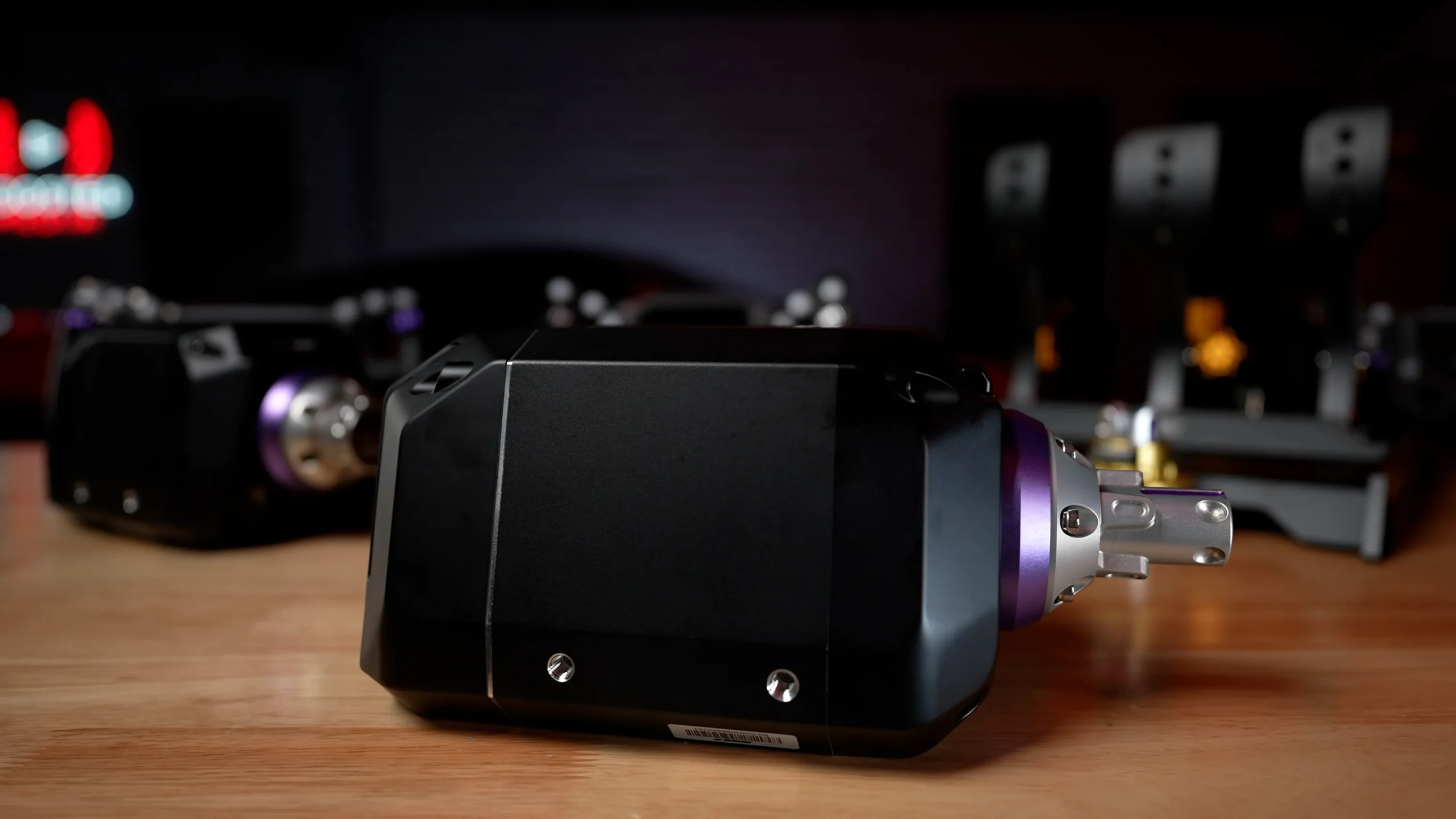
We found the visual design genuinely appealing. They look premium without being too over-styled, and they strike a good balance between standing out and still looking like serious sim racing hardware. Material quality also looks broadly appropriate for the price bracket, with CNC-machined aluminium housings and plastic back cover.
Mounting is straightforward as well. The bases line up with familiar mounting standards, including Fanatec-style bottom mounting patterns, and side mounting options are available too, making the installation side of the ownership experience fairly well covered.
In use, we did not run into any overheating or thermal throttling issues, even with both bases being pushed hard for long periods. But once we looked beyond the outer shell, we did start to become a bit more critical.
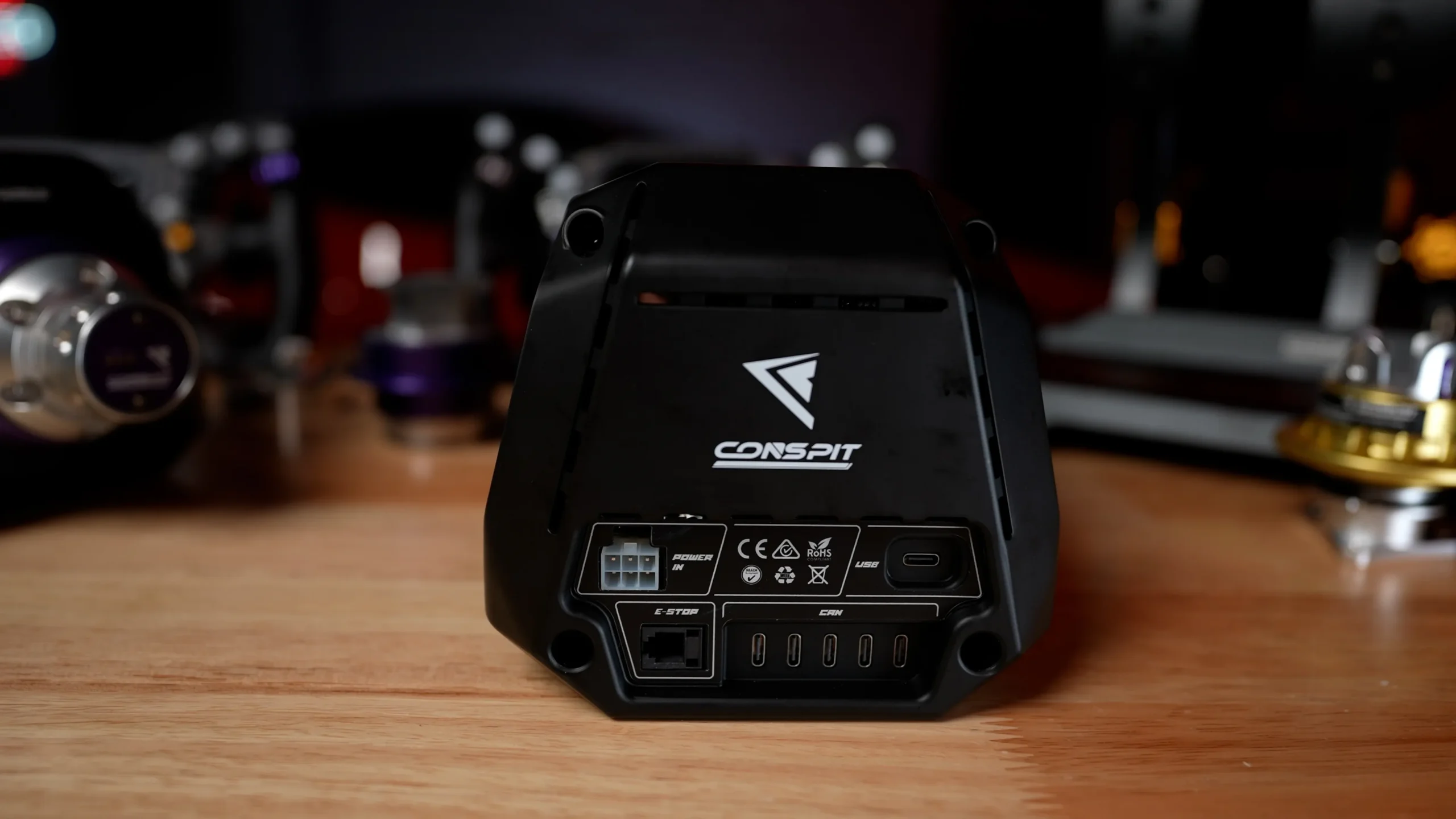
Internally, the layout did not feel as refined as some of the stronger alternatives in the category. One thing that stood out straight away was the design philosophy around the rear housing and internal boards. Rather than the housing sliding off and leaving the main board behind, the interface board is mounted to the housing itself, which means there needs to be quite a bit more cable slack inside the unit.
To CONSPIT’s credit, the internal connections themselves are generally neat enough, with proper connectors for the motor phases and a solid plug connection for the braking resistor. But there is also quite a bit of excess cable length inside, and once everything is pushed back together, some of those cables end up sitting against components on the PCB that get warm during operation, particularly around the power delivery section.
There is also no obvious active or passive cooling inside, with no visible heatsinks on the power delivery components and no fan-based cooling either. That does not mean the internal design is bad, and we did not see any outright issues in testing, but there is room for improvement here to provide more confidence in the long-term durability of the wheelbases, particularly when other brands have taken extra steps in this area.
On paper, the hardware story is strong. CONSPIT makes a point of talking about encoder resolution, optical encoder design on the upper-tier bases, and motor design choices intended to improve smoothness and reduce cogging.
Those are fair technical talking points, but specs alone do not tell the whole story. A high encoder resolution and a nice set of engineering bullet points do not automatically translate into a better real-world experience.
Driving Experience
This is where our observations became much more mixed, and did not entirely line up with some other reviews and user experiences.
The hardware itself does not appear to be the problem. We found the motors smooth, responsive and fundamentally capable, and there were definitely situations where that came through clearly.
What we kept running into was a lack of overall refinement. We both came to the same conclusion: there seemed to be a fairly narrow window where the bases felt right, and once you moved outside of that in an effort to fine tune things to personal preference, the force feedback started to lose coherence. We also noticed regular moments where force events felt out of balance with one another, with sudden spikes or jerks that did not feel natural relative to the rest of what the car was doing.
That made the force feedback feel less communicative than the alternatives in this category. Individual elements like responsiveness and smoothness were good, but the overall delivery was not as polished or as consistent as it needs to be.
That is really the theme with these wheelbases. The hardware is promising, and the underlying performance is there. But the last layer of refinement that turns a capable direct drive wheelbase into a genuinely great one did not feel fully developed yet.
The encouraging part is that these are also the kinds of issues we have seen from other brands in the past that have later been improved significantly through firmware revisions. So while we can only comment on what we experienced from the CONSPIT wheelbases at the time of testing, this does feel like an area of performance that could evolve significantly over time.
CONSPIT EVO PEDALS
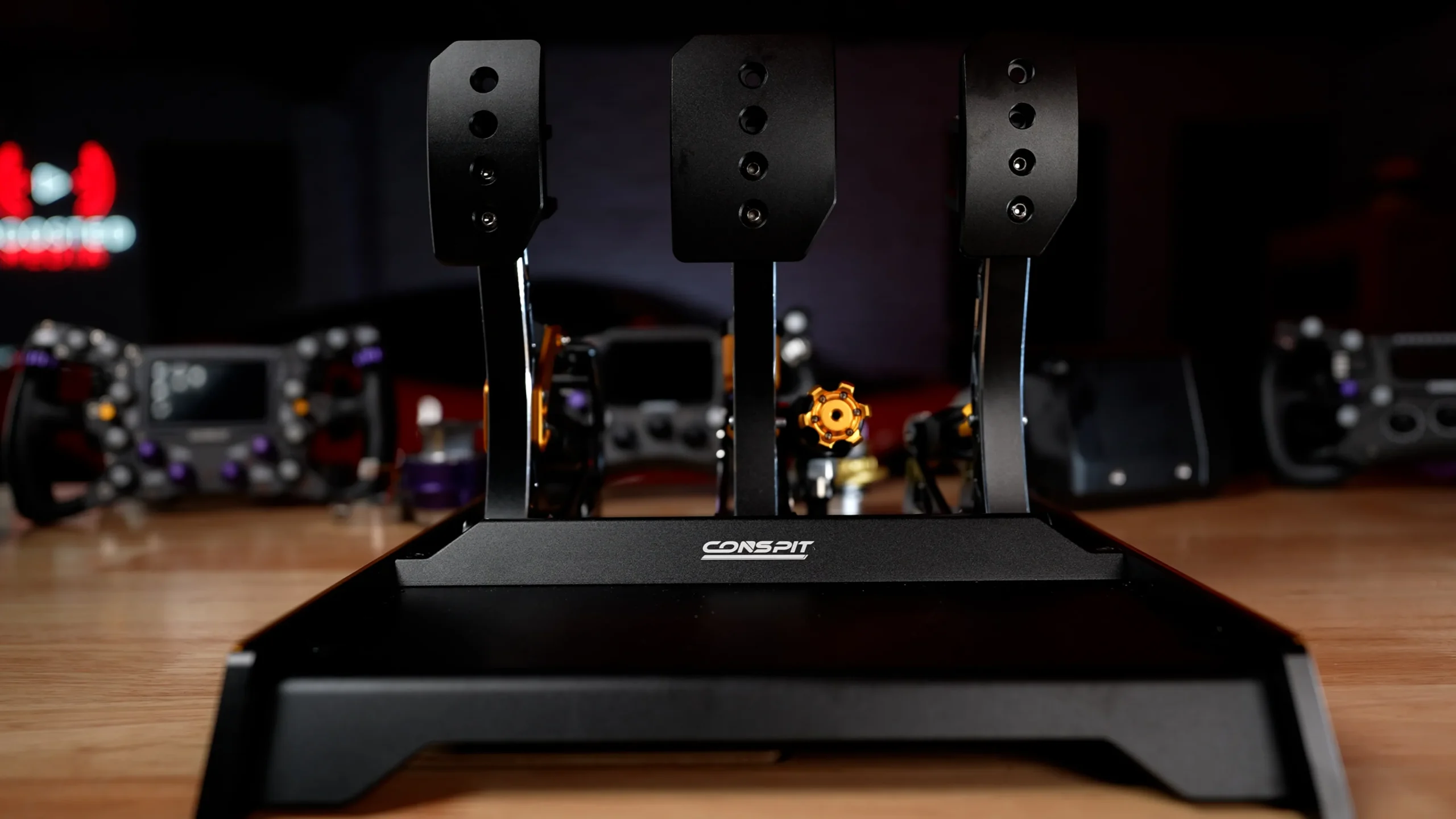
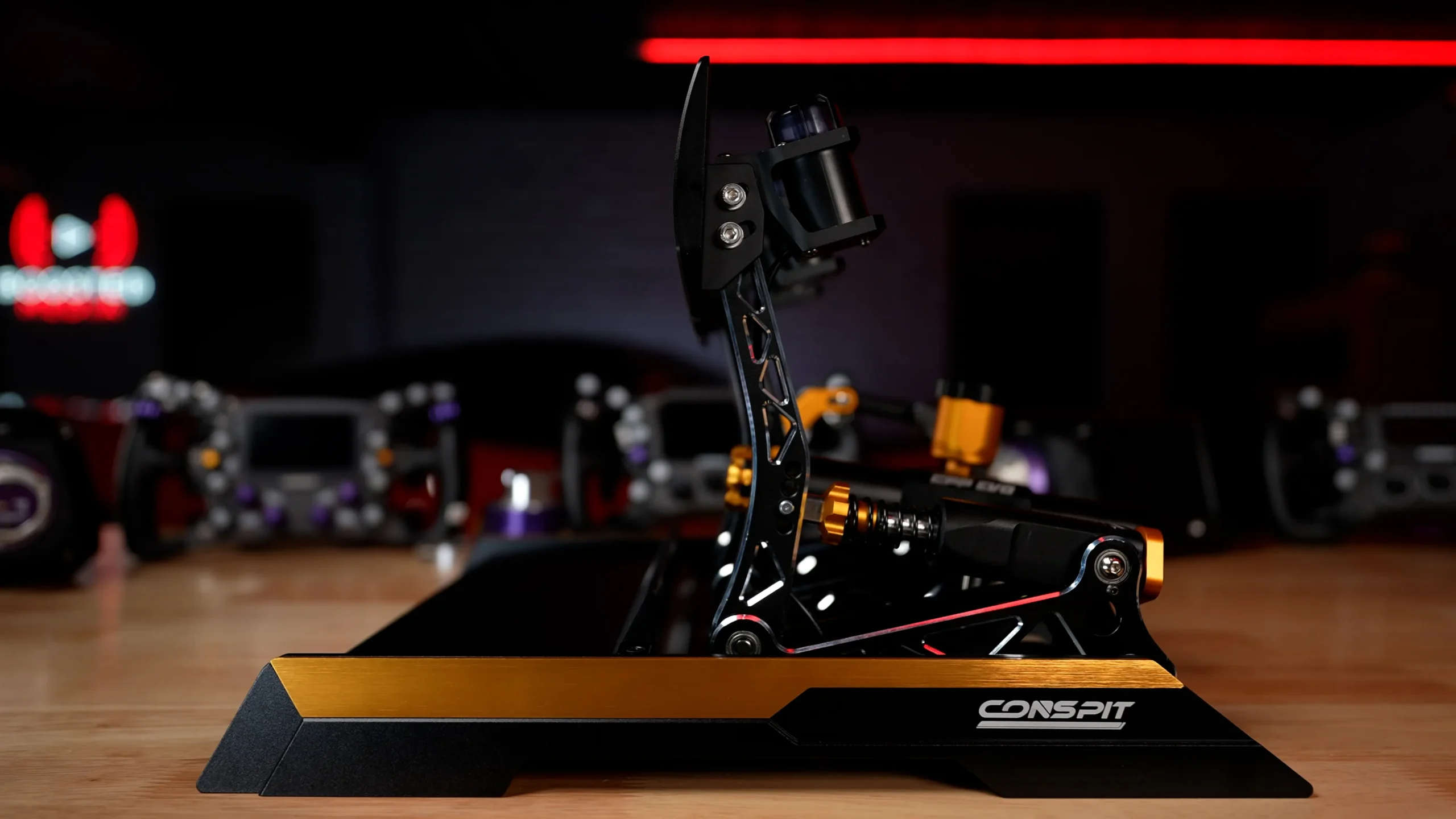
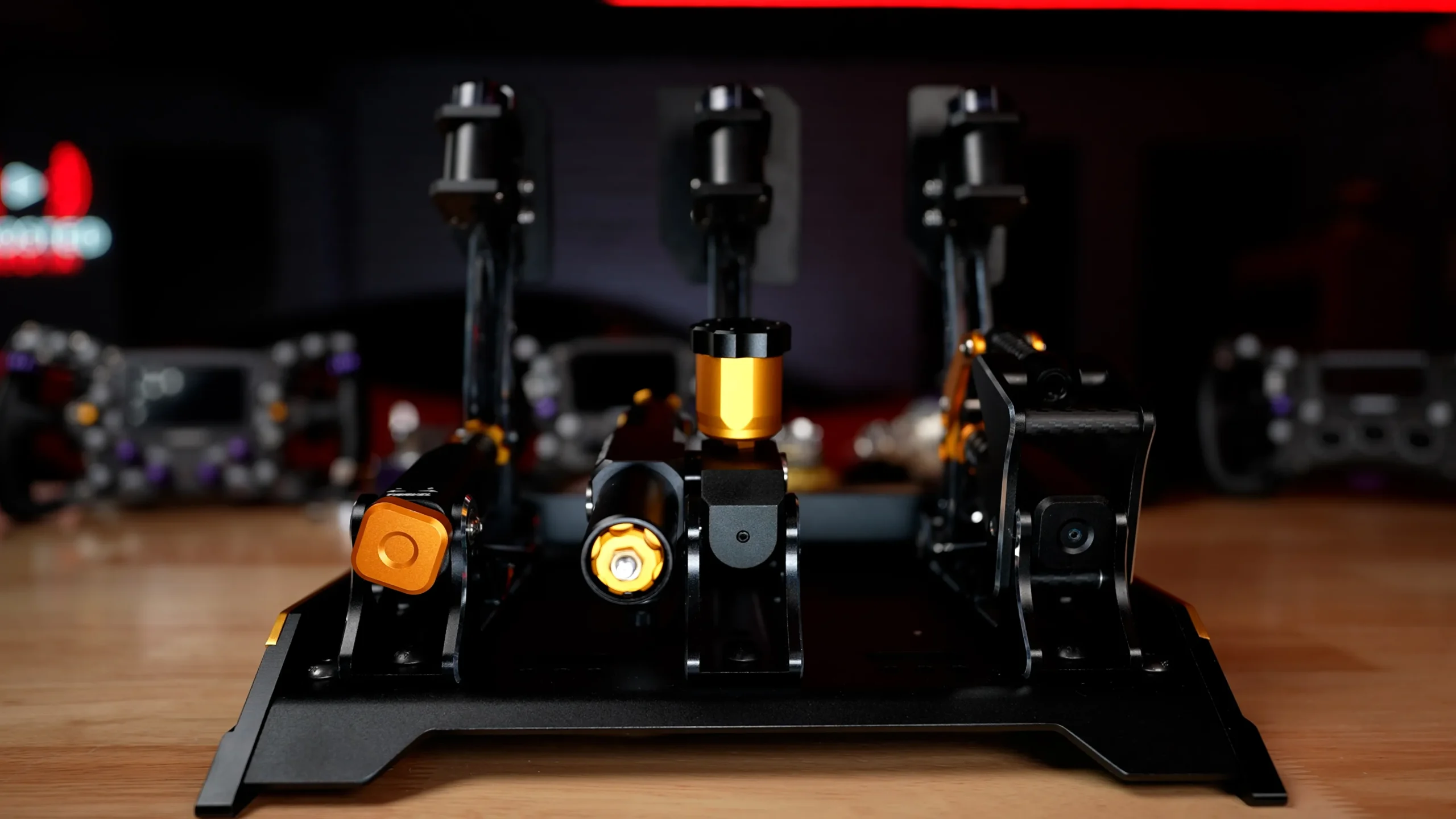
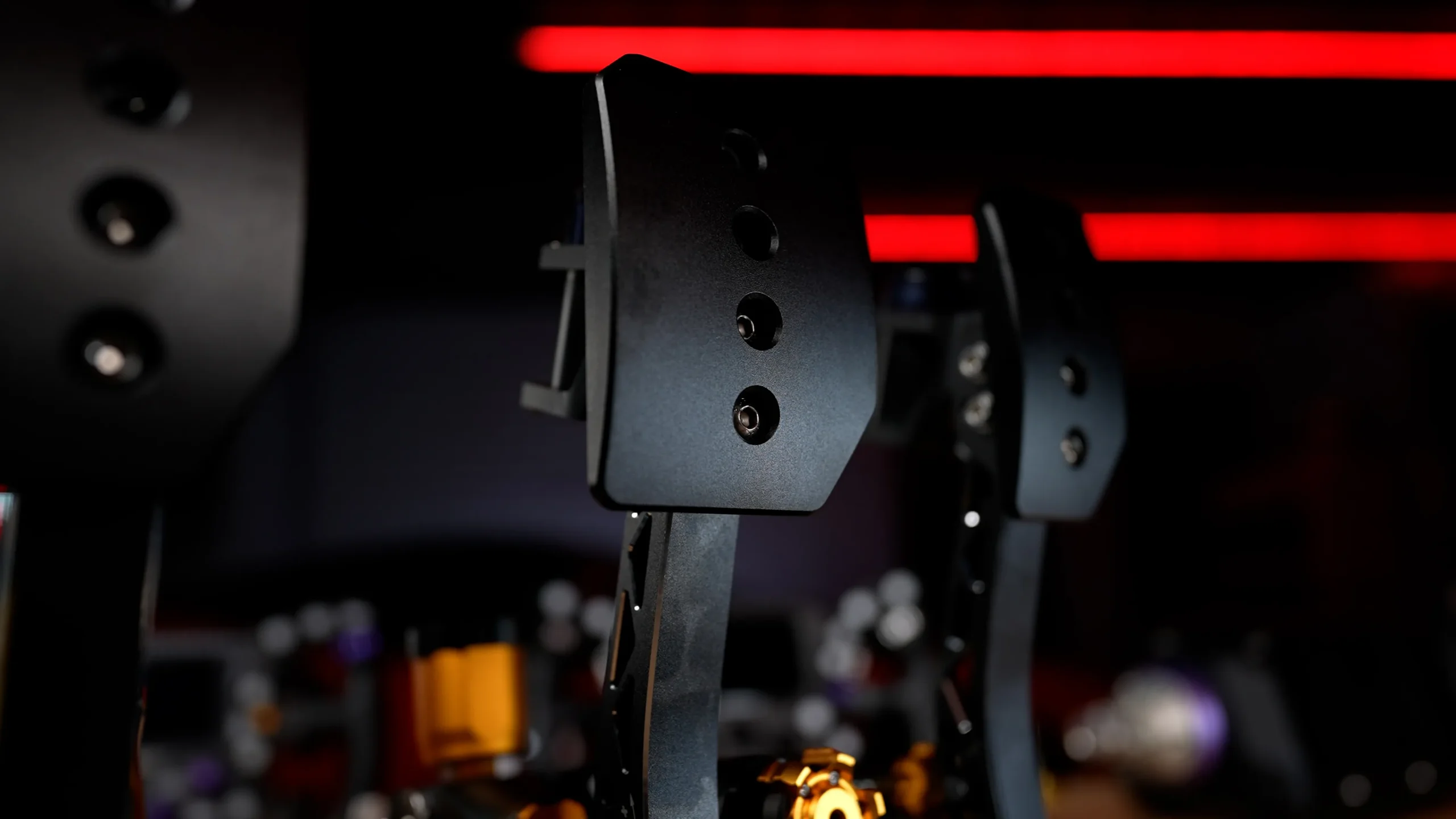
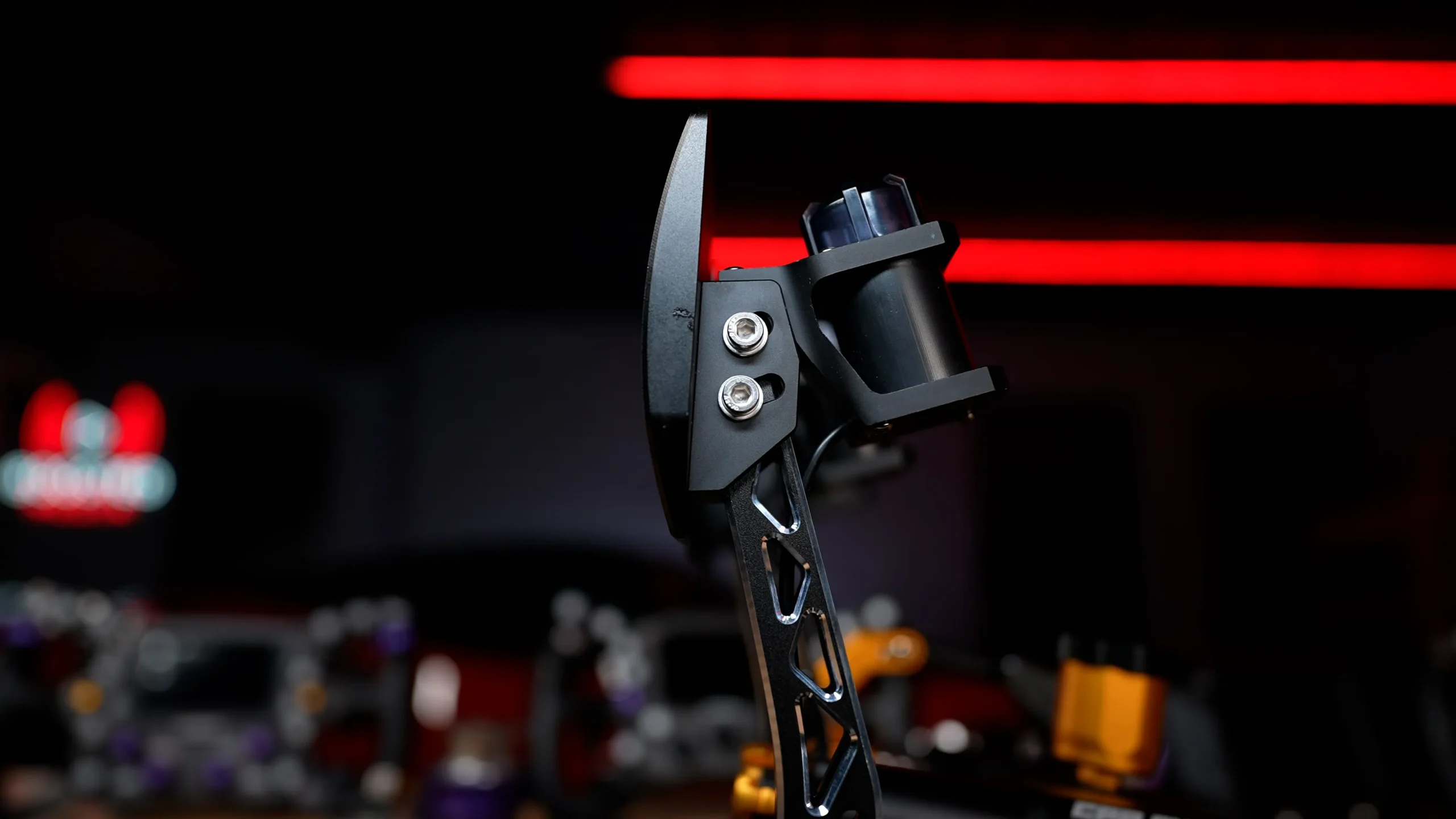
The CPP EVO 3-pedal set is the most expensive pedal set in the CONSPIT range, and visually it makes a very strong impression.
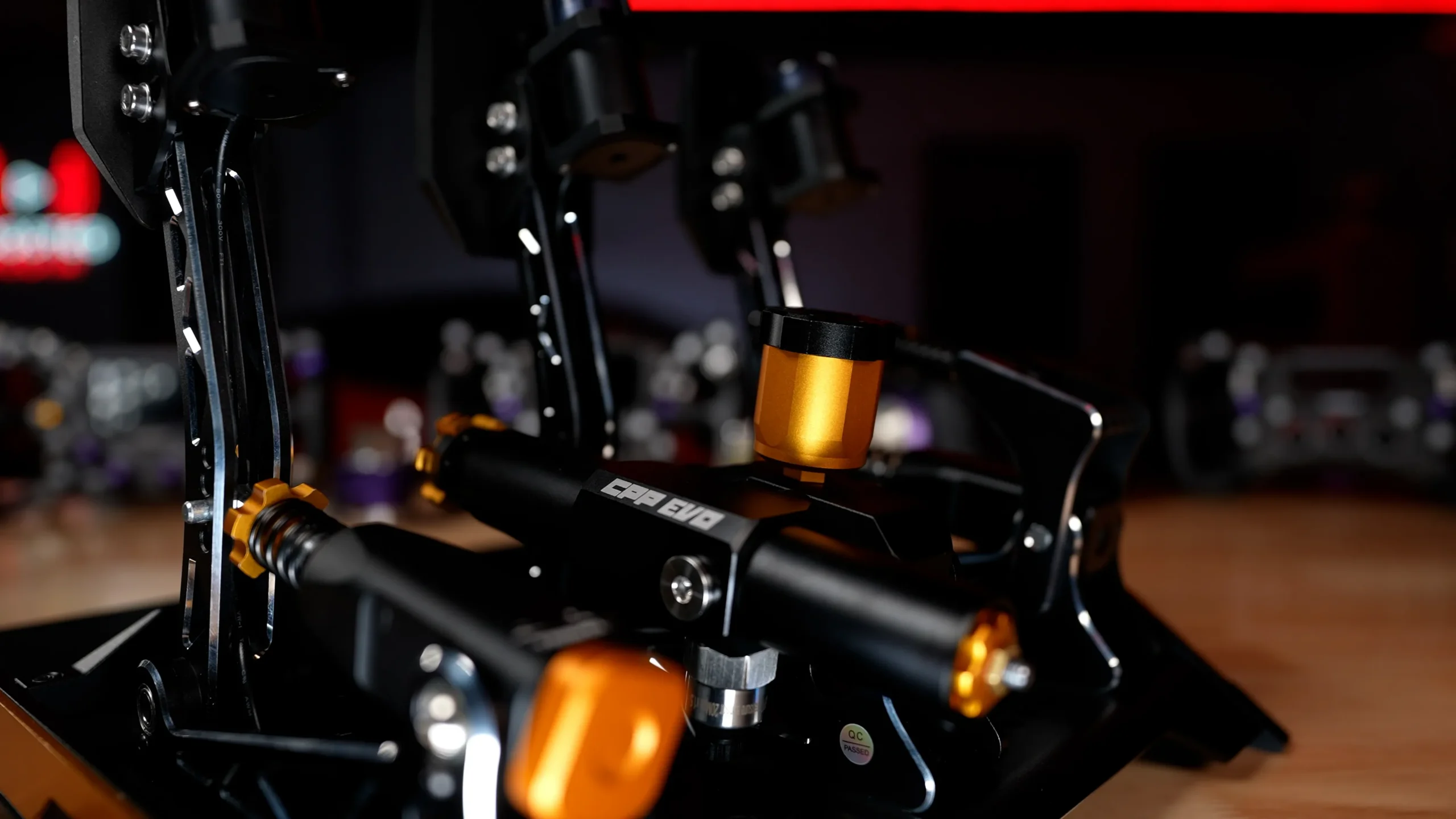
There is a lot packed in here: CNC-machined alloy construction with a sandblasted and anodized finish, Hall effect sensors on the throttle and clutch, a closed hydraulic brake design, and vibration motors on each pedal. There is also a broad range of adjustability for both ergonomics and pedal feel, including pedal angle and height adjustment, a four-step quick adjustment system for throttle and brake force, and preload adjustment for finer tuning.
In terms of outright feel, the throttle is good. We liked the adjustment mechanism and found the action smooth and easy to work with. The clutch was less convincing. Early on it felt grainy and rough in operation, and a closer look showed visible material wearing off the sleeve as the mechanism bedded in. It did become smoother over time, but that improvement appeared to come from wear rather than from a particularly refined design, which does raise some concerns about the long-term quality of the mechanism.
The haptics are a nice inclusion. They can be controlled through the CONSPIT software or through SimHub, which is exactly what you want to see in a modern sim racing ecosystem. But these are still vibration motors rather than a more advanced haptic solution, so while they can communicate useful cues, they are not operating on the same level as more sophisticated systems or active pedals.
The brake is where things became more complicated.
On paper, the hydraulic design sounds impressive, and it does change the way the pedal behaves underfoot. But we have been saying for a long time that hydraulic does not automatically mean better. What matters is repeatability, consistency and long-term feel. In use, we noticed flex in the pedal tray under heavier braking, particularly in the firmer configurations. It was not catastrophic, but it was there, and it is not what you want when a product is supposed to deliver precise and repeatable braking feel.
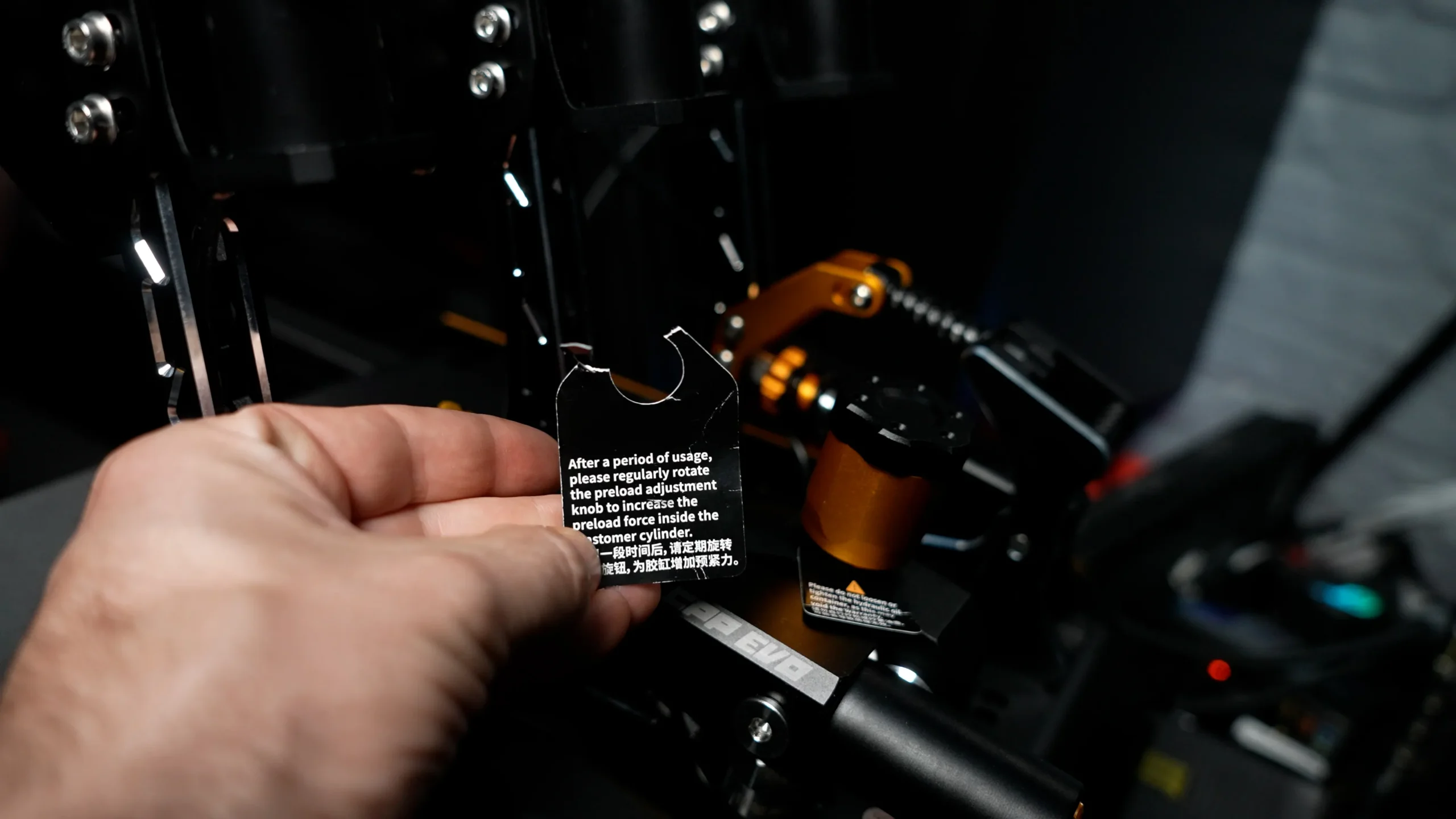
We also had concerns around the long-term consistency of the elastomer system, highlighted by warning labels on the pedals. One of the tags fitted to the brake instructed users to increase preload after a period of use. That is a red flag, because consistency is absolutely critical with a brake pedal. If the feel is expected to drift enough that regular preload adjustment becomes part of the normal ownership experience, that is not ideal for building and maintaining muscle memory.
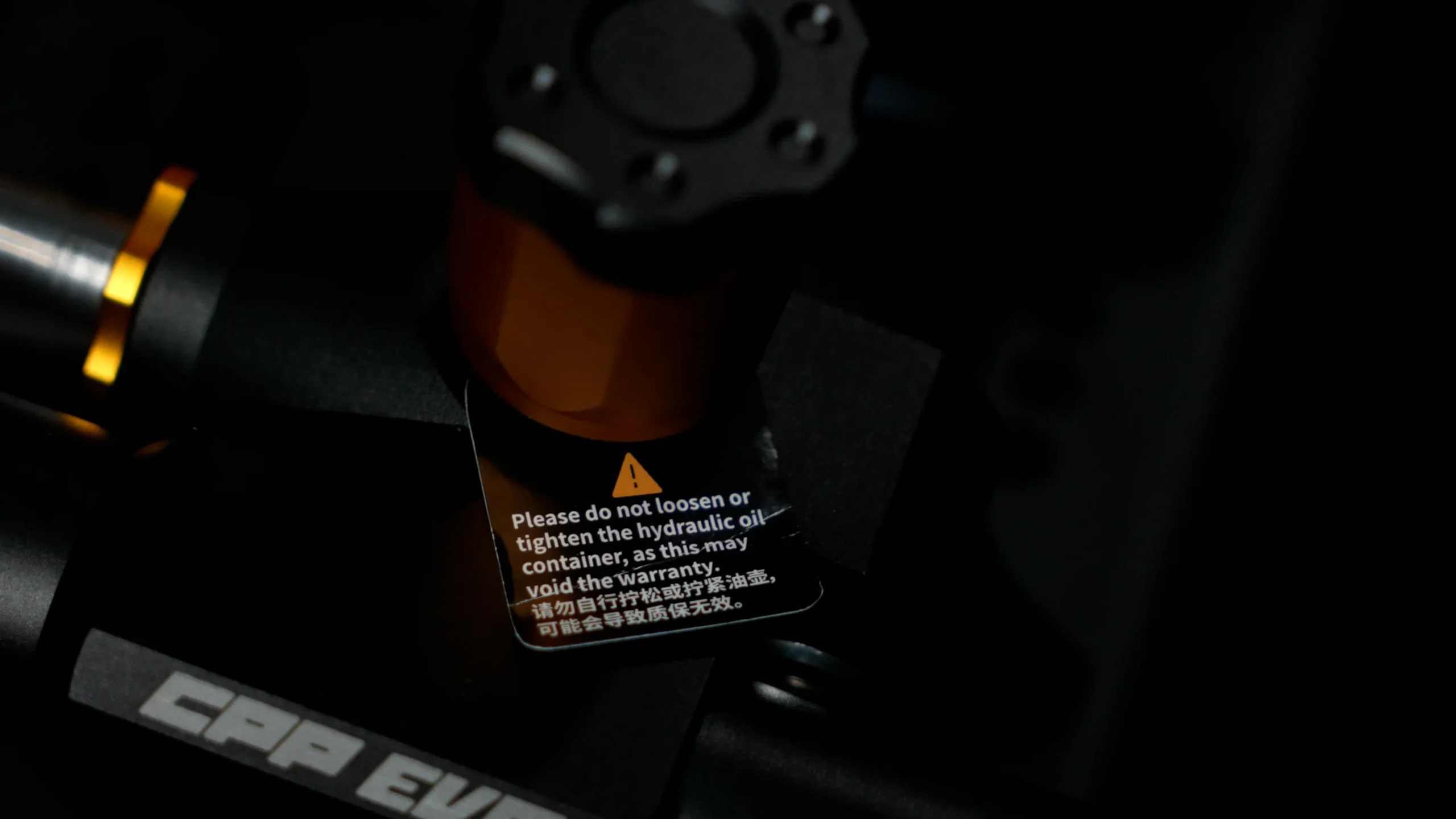
The external reservoir raised even more questions for us. Another warning label specifically instructed users not to loosen or tighten it, but when we investigated further it appeared to be bone dry and completely isolated from the sealed hydraulic system. In other words, it gives the impression of being a meaningful functional part of the brake assembly, but in practice it does not appear to serve any real mechanical purpose beyond aesthetics.
That matters because it speaks to a broader theme with the CONSPIT gear. There is a lot here that looks impressive at first glance, and parts that are genuinely good. But once you start digging deeper, some of the details feel less convincing than the presentation suggests.
So overall, the CPP EVO is not a bad pedal set. It has a strong feature set, a lot of adjustability, good haptics, and a smooth throttle. But the clutch refinement, brake tray flex, preload warning, and questionable reservoir design all take away from what could otherwise have been a much stronger package.
CONSPIT Steering Wheels
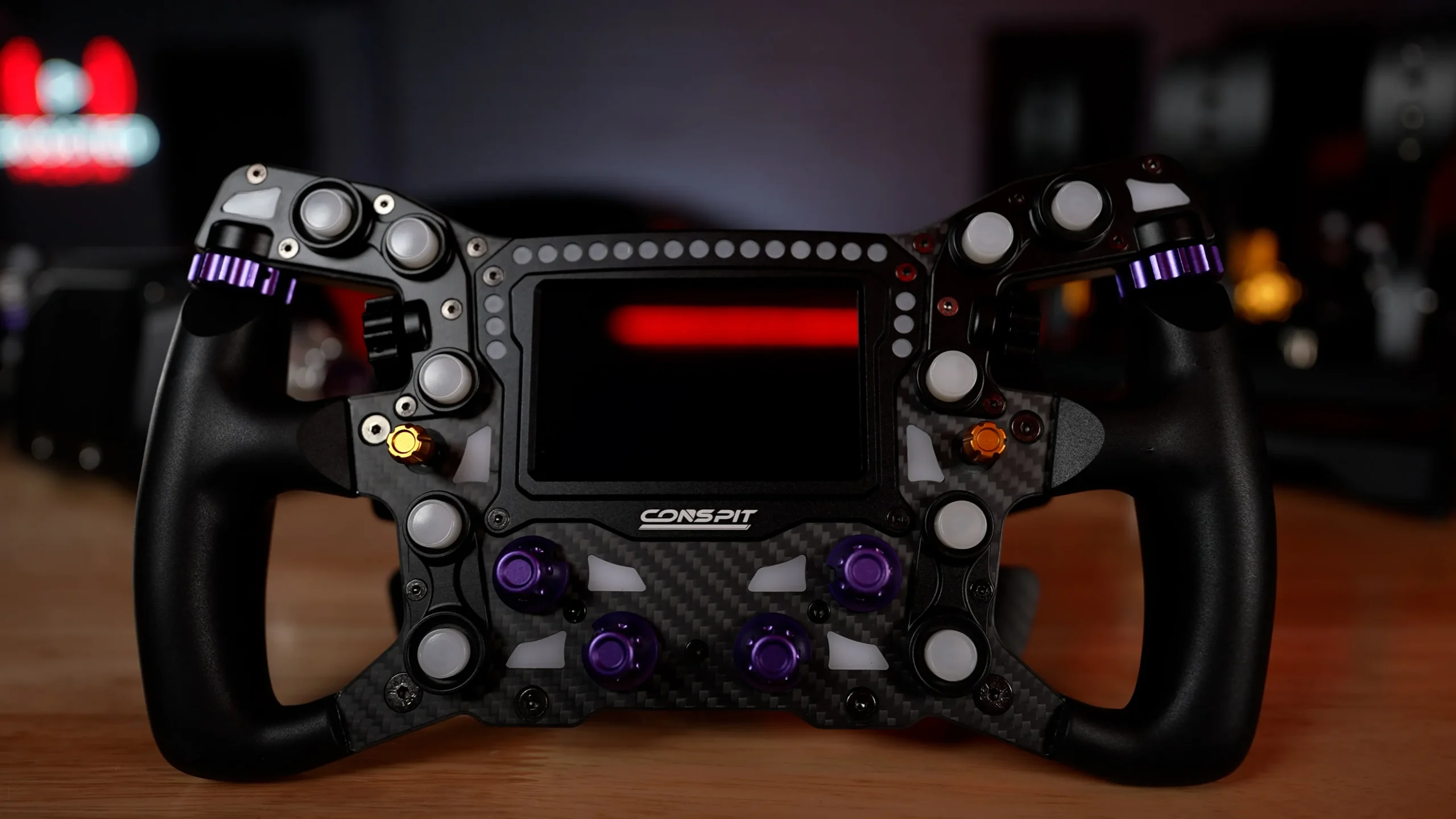
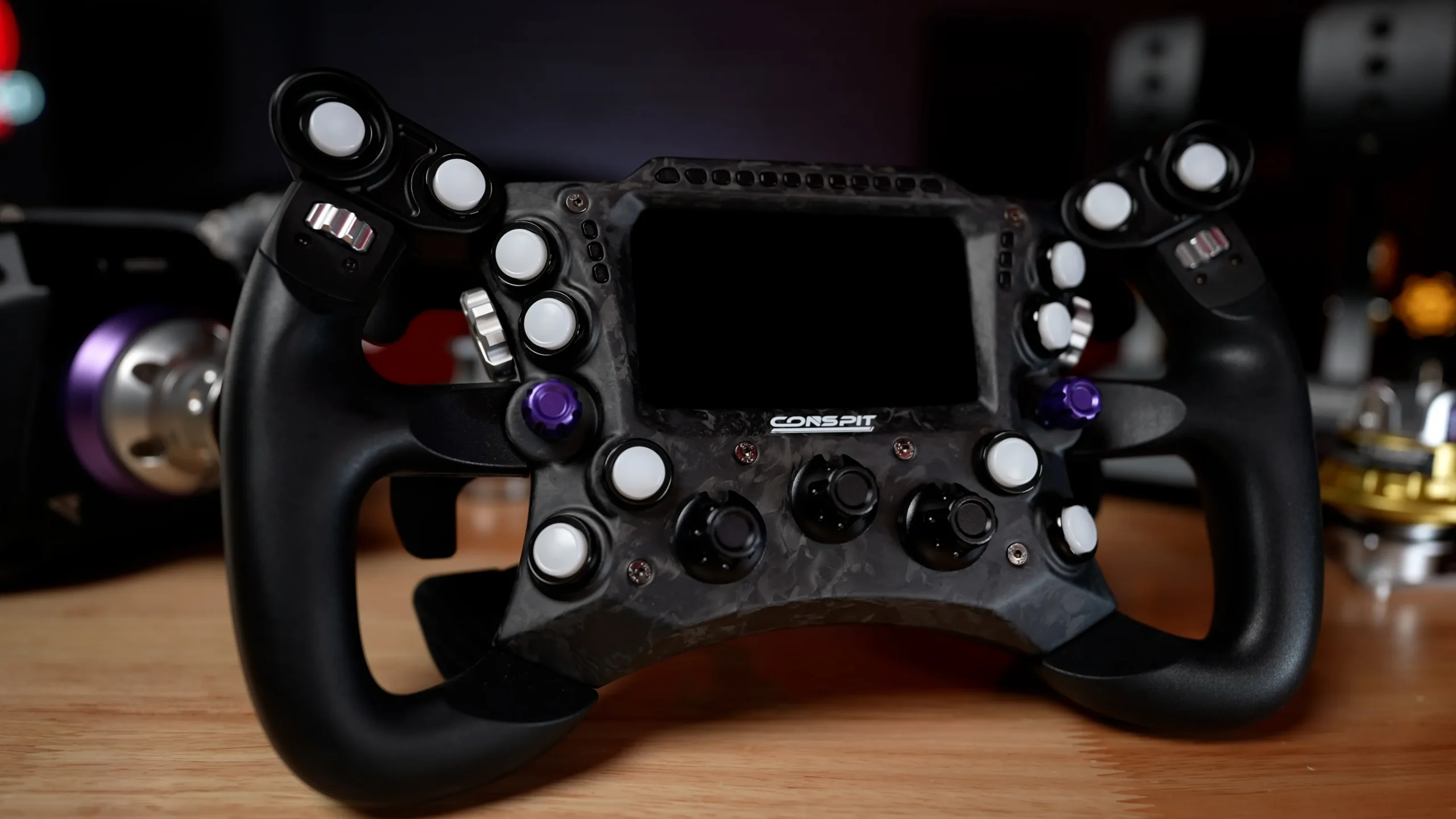
Of all the hardware in the CONSPIT ecosystem, the steering wheels ended up being the most consistently impressive part of the experience for us. There were some obvious quality control issues with earlier samples we received, but later units showed clear improvement, and once we spent time with the more recent wheels, they left a much stronger impression.
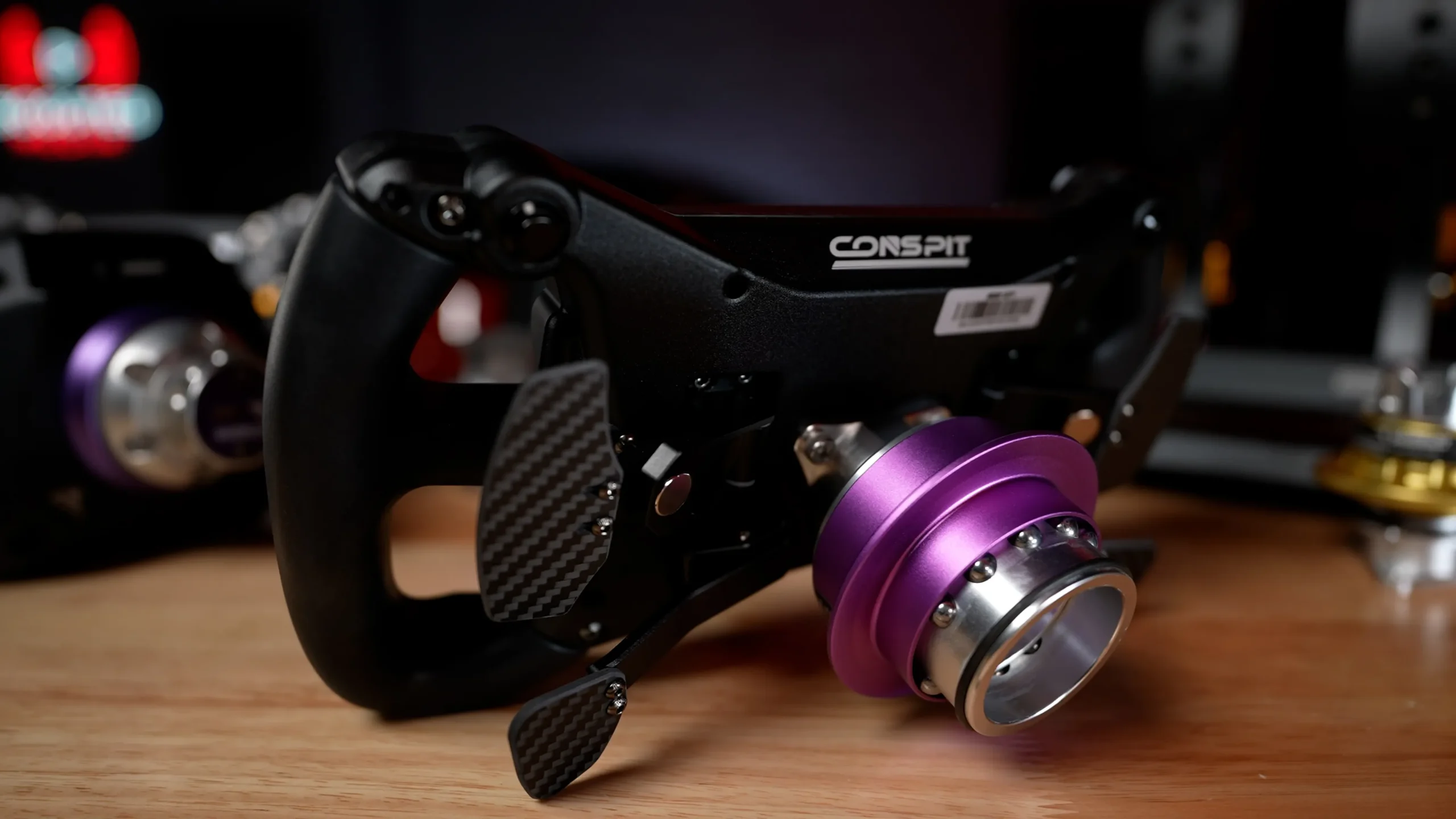
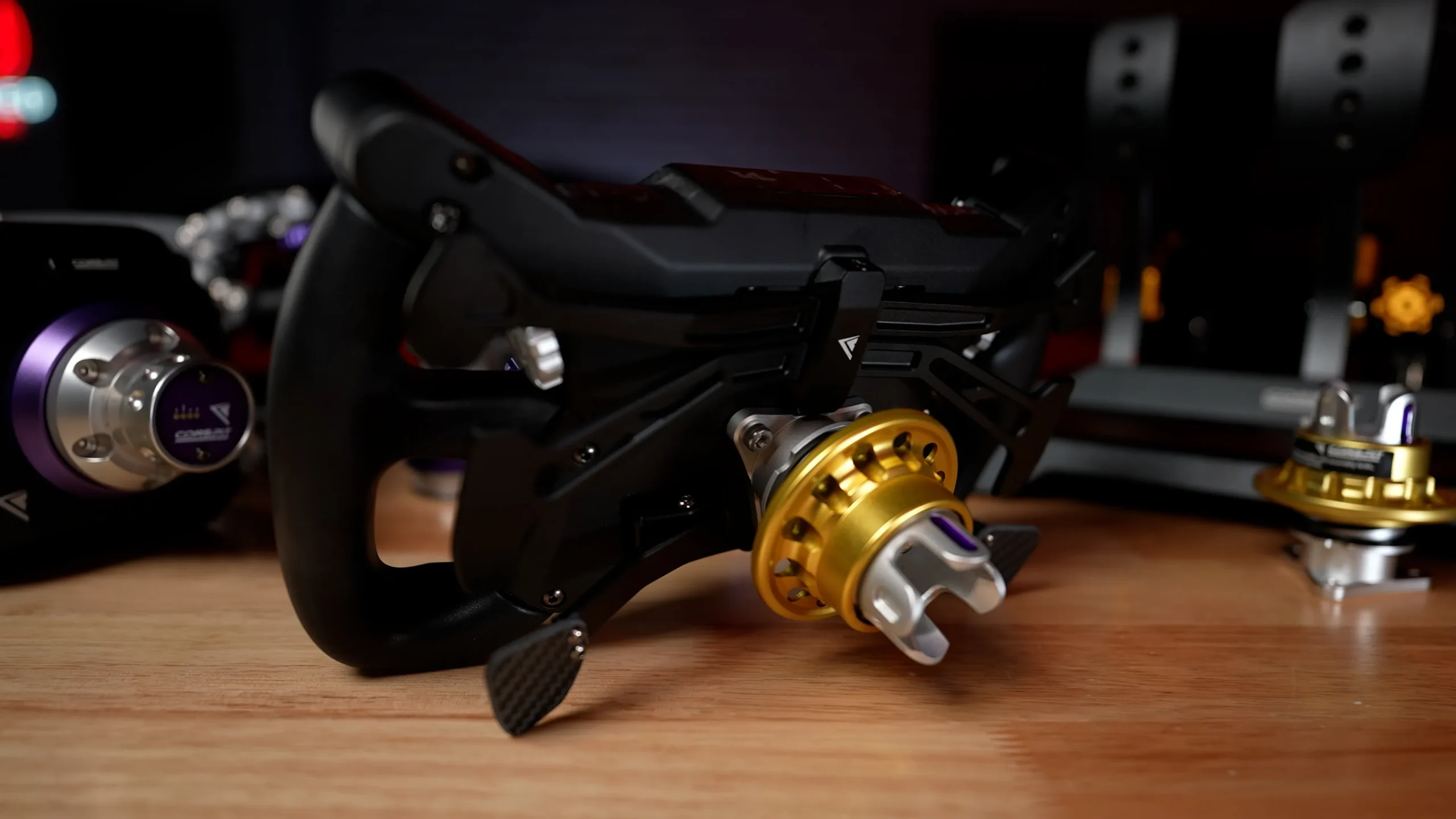
Across all three models, the general formula is quite similar. You get a mix of alloy and carbon fibre construction, good overall fit and finish, solid shifter action, and ergonomics that feel well judged rather than over-designed. In the hand, they feel like serious sim racing products, and importantly, they deliver a very good driving experience with all the key inputs and display functions well covered.
That was probably the biggest strength of the three wheels we tested. Grip shape, thickness, material choice and overall ergonomics all worked very well, and all three felt intuitive to use. The buttons and controls are not the most premium we have ever felt, but they are absolutely good enough for the price point, and the magnetic shifters in particular feel solid.
The MAX 01 was the standout for us. It offers a very strong feature set for the money, and importantly, it is also SimHub compatible, which is a big plus if you want more flexibility with dashboard integration. It also felt the closest to a genuinely high-end product in day-to-day use, and did not come across as dramatically cheaper than some much more expensive alternatives.
The 290 GP and 300 GT were also good in terms of ergonomics and general usability, but unlike the MAX 01 they rely on CONSPIT’s own dash ecosystem rather than offering the same SimHub compatibility. That does not make them bad wheels by any means, but it does create a bit of inconsistency across the range that we would rather not see. Ideally, that level of software flexibility would be available across the lineup.
So while the wheelbases and pedals left us with more mixed feelings, the wheels were a clear positive. They are comfortable, feature-rich, enjoyable to use, and offer a lot for the money.
All CONSPIT wheels include a standard 70mm bolt pattern adapter and a solid USB connection for easy integration with virtually any brand of wheelbase, so even if you are not interested in the CONSPIT wheelbases themselves, the wheels are still well worth a look.
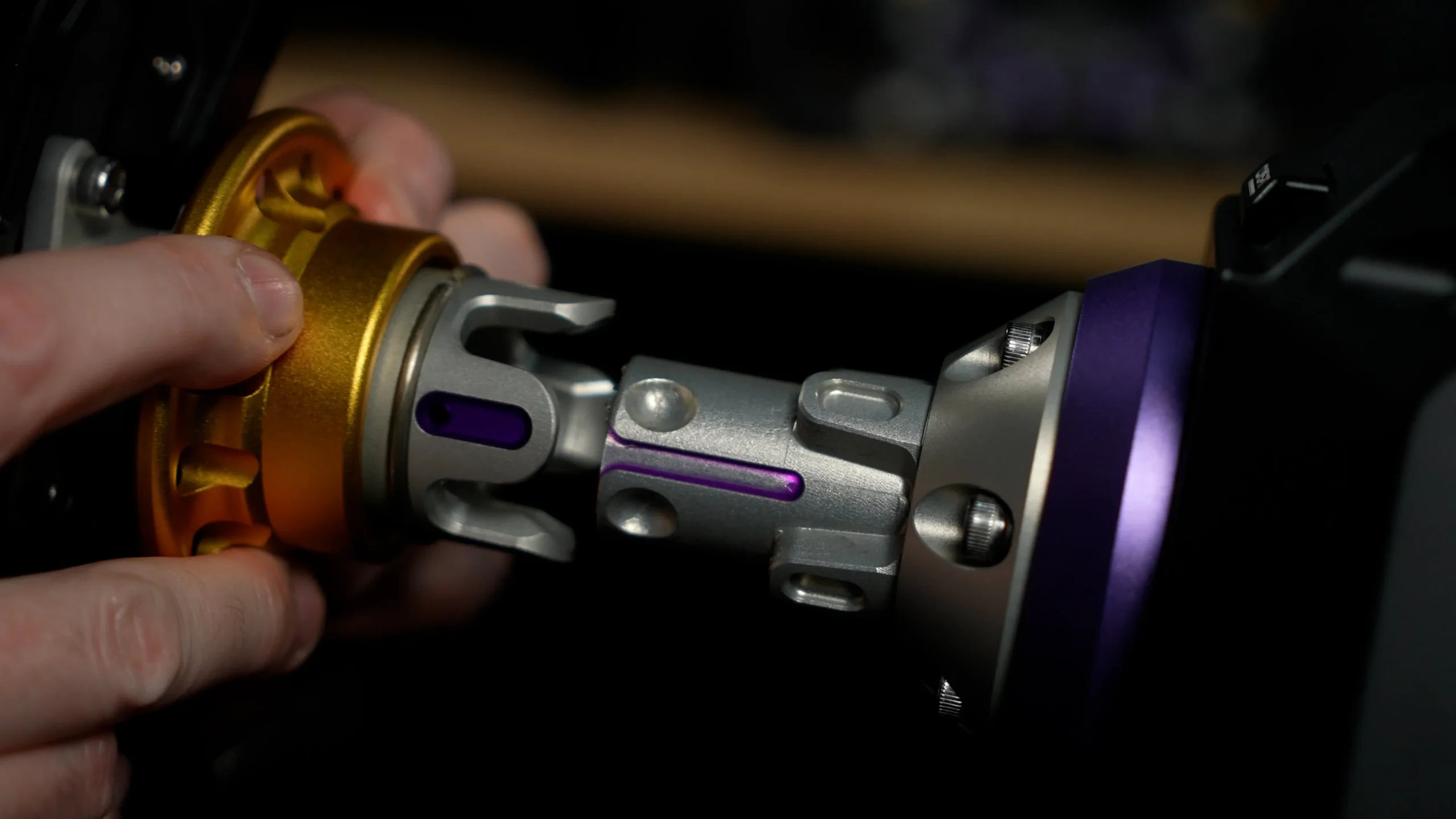
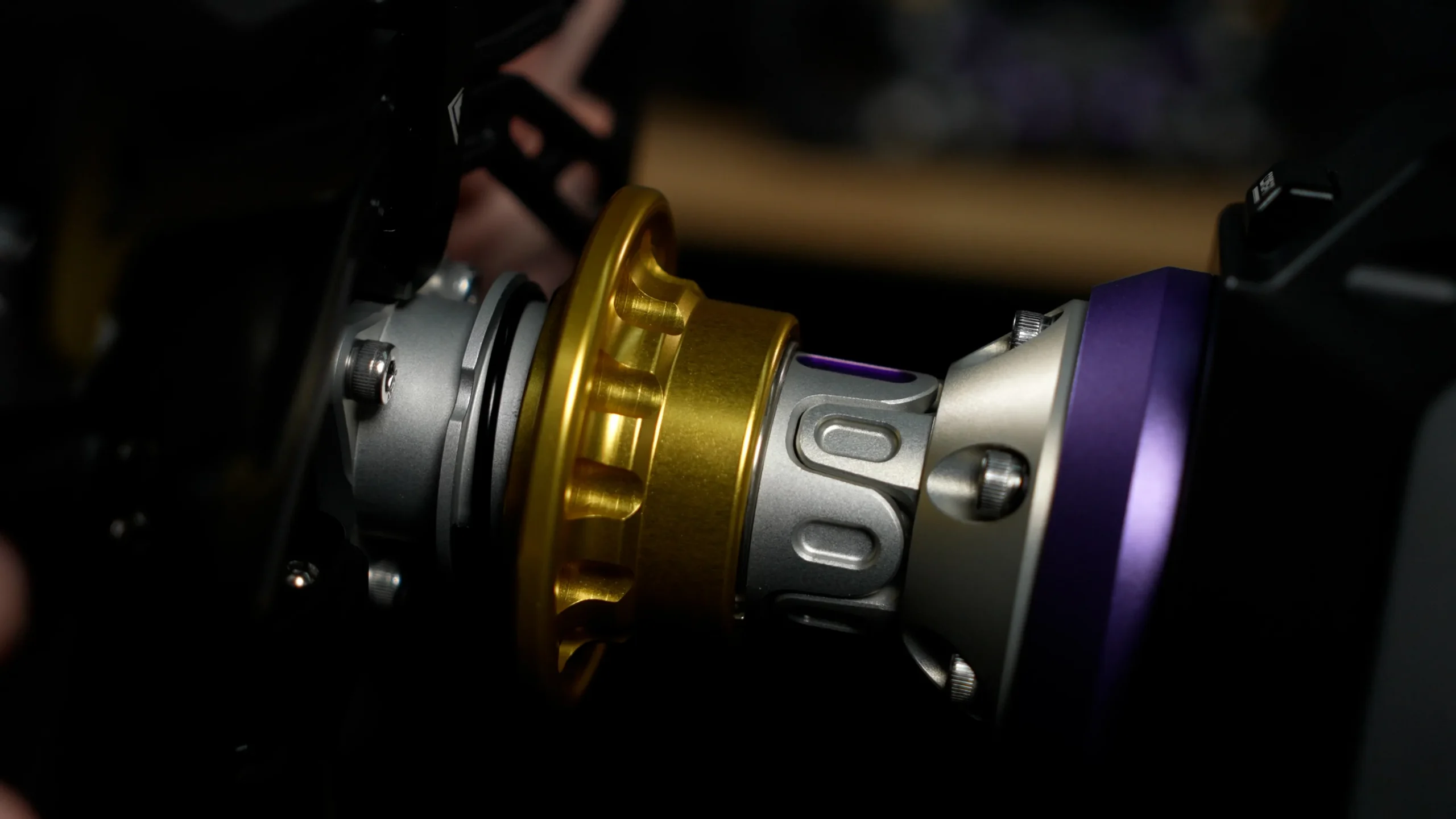
CONSPIT Quick Release System
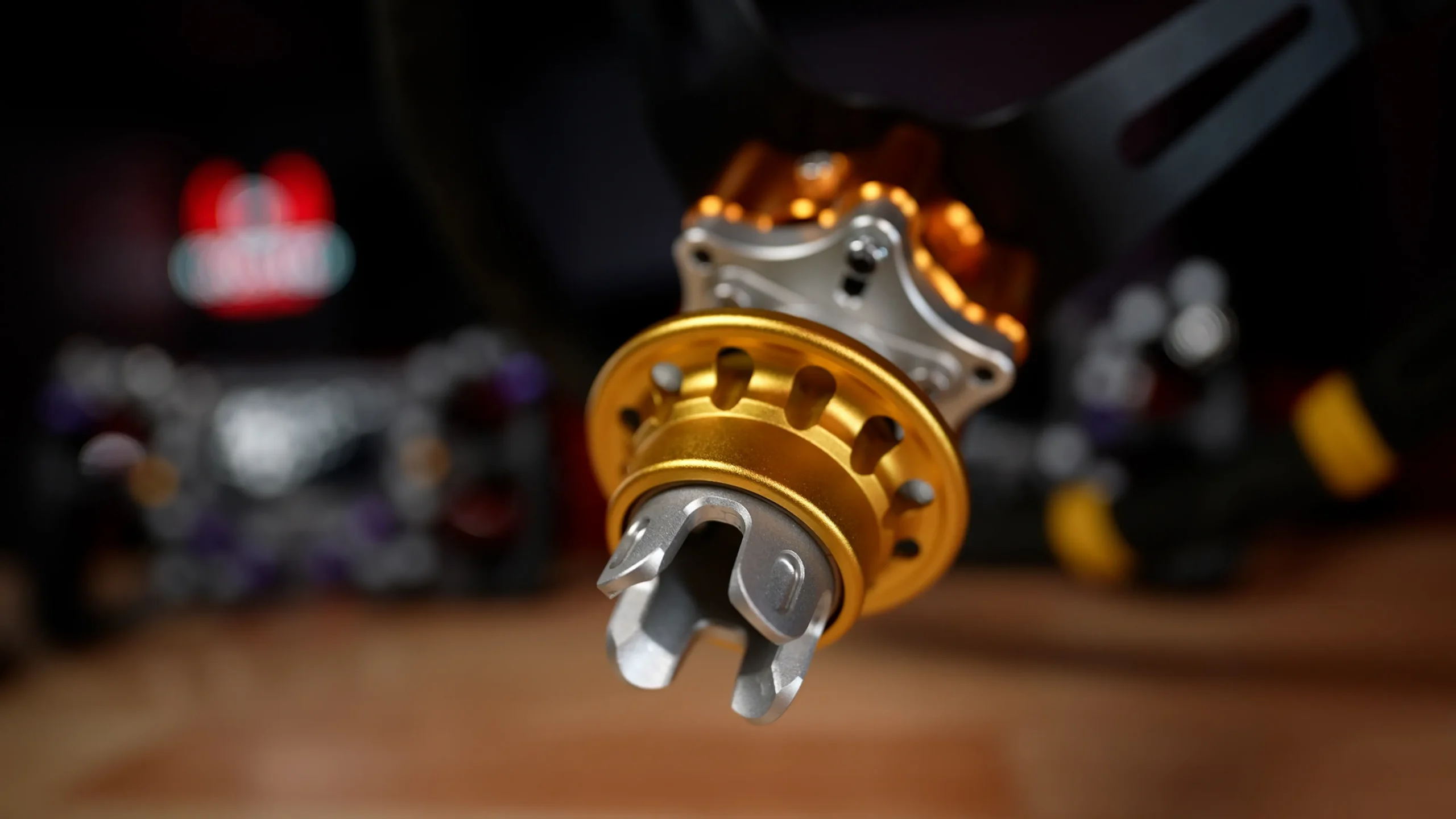
There are two main variants, CDR and CDP, and both are designed to give buyers flexibility depending on the type of wheel setup they want to run. More importantly, CONSPIT has clearly put thought into making the ecosystem easier to expand, with relatively affordable wheel-side options, adapters, and USB passthrough solutions that make third-party integration less painful than it is with some competing brands.
Quick releases are often where the true cost of an ecosystem starts to creep up. It is one thing to buy a wheelbase, but once you start adding extra wheels, third-party rims and adapters, the cost can escalate very quickly. CONSPIT deserves some credit here for trying to keep that side of the ownership experience relatively accessible.
In theory, the CDP design is the more ambitious of the two. It uses a spline-style interface that should provide a very solid connection, while the CDR is more in line with the D1-style quick release many sim racers will already be familiar with from brands like MOZA and Simagic.
Unfortunately, this was also one of the clearest weak points in the CONSPIT ecosystem for us.
The CDR setup was the better of the two in our testing, but even then it varied significantly between samples. Some units felt excellent, with no discernible slop or movement at all. Others had noticeable play, which is exactly the sort of thing you do not want in a quick release.
The CDP design was more concerning. Across multiple combinations, we kept finding play in the system. That was disappointing, because the concept itself is quite clever and, in theory, it should be the more solid solution. But in our testing, it simply did not deliver the secure connection we were hoping for.
So while the CONSPIT quick release ecosystem deserves credit for its openness, pricing and general design ambition, this is also one of the clearest areas where the execution still needs work. The ideas are good, but the manufacturing consistency was not where we would want it to be at this point in time.
Software: Conspit Link 2.0
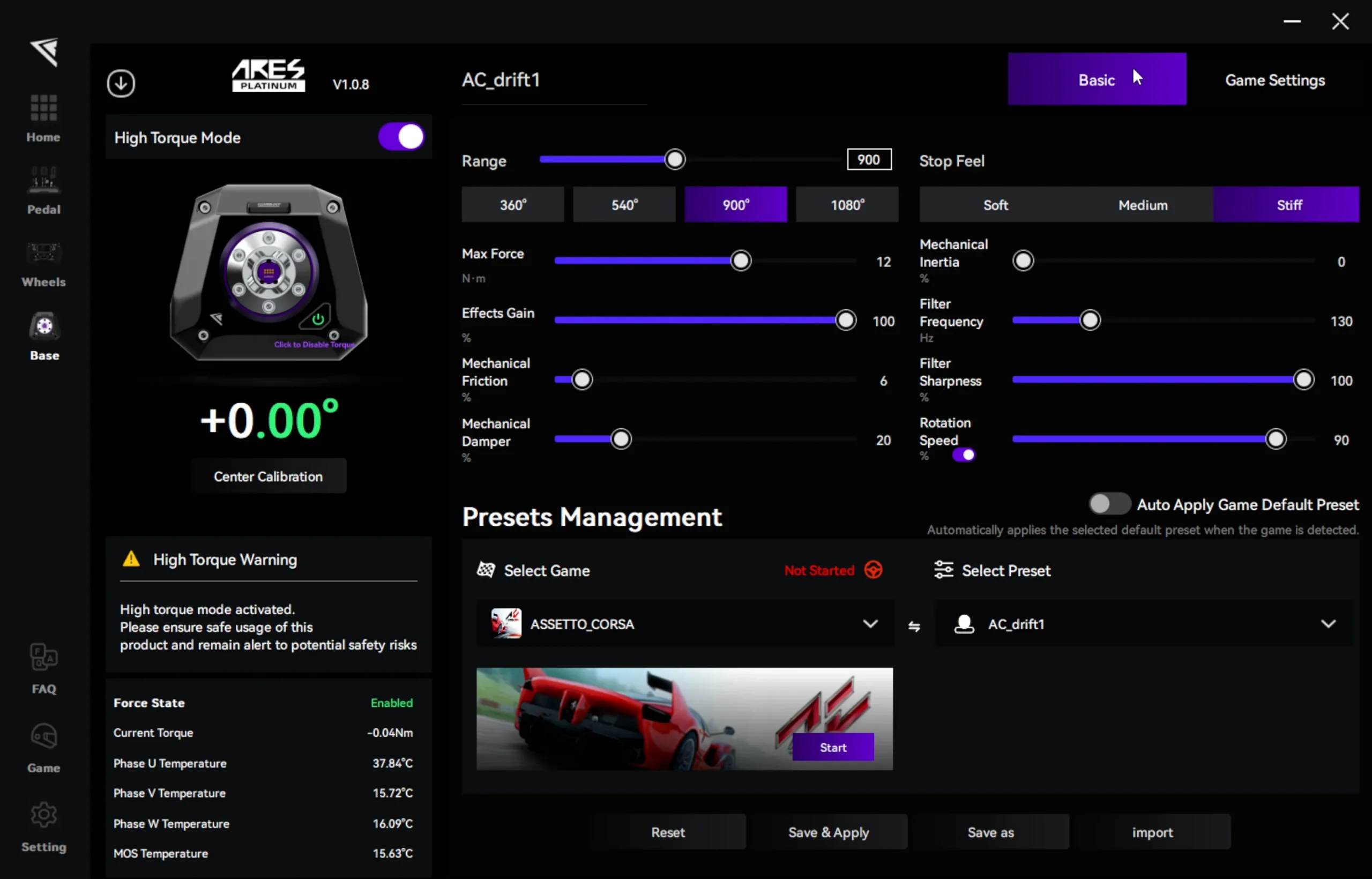
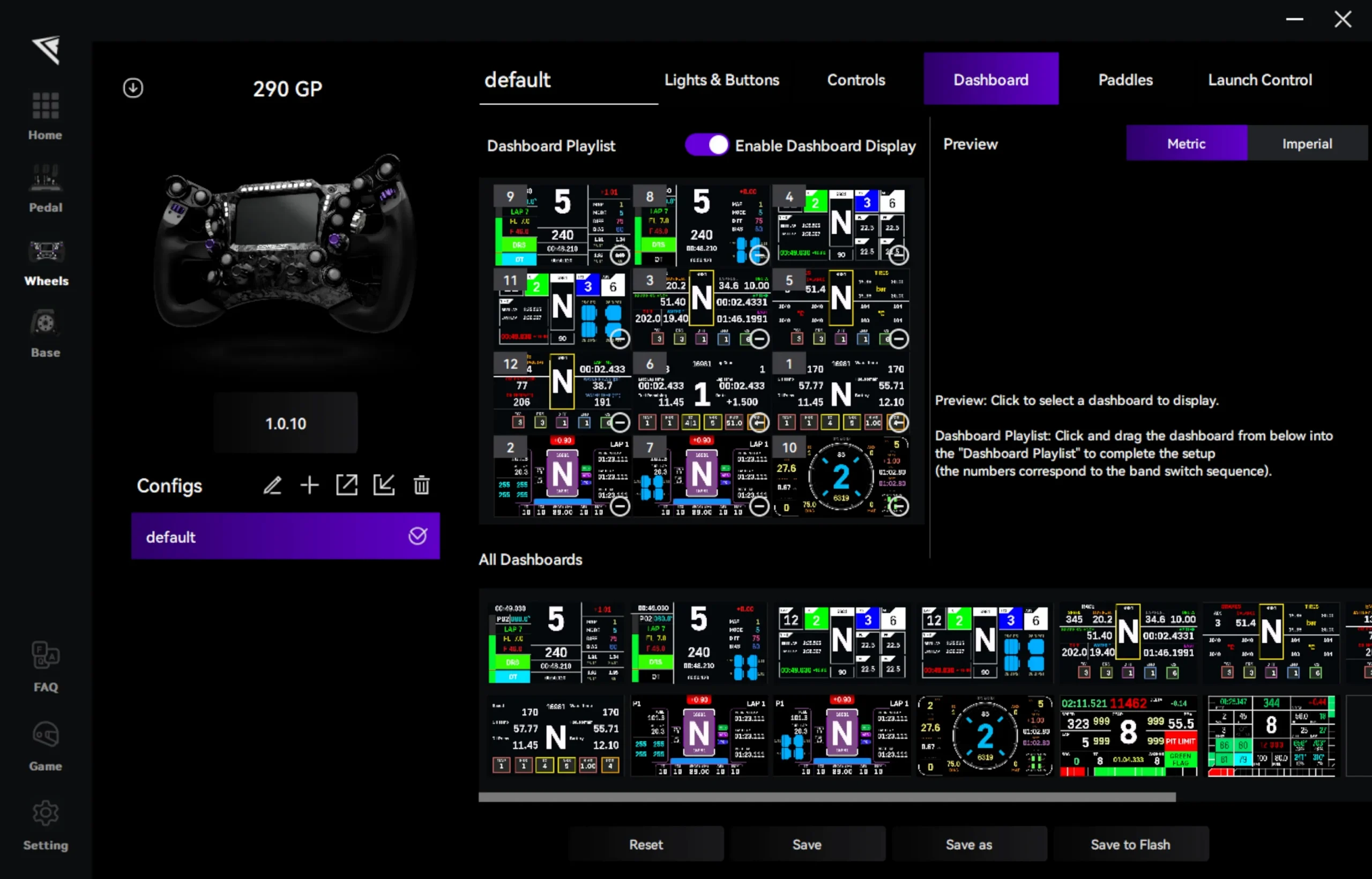
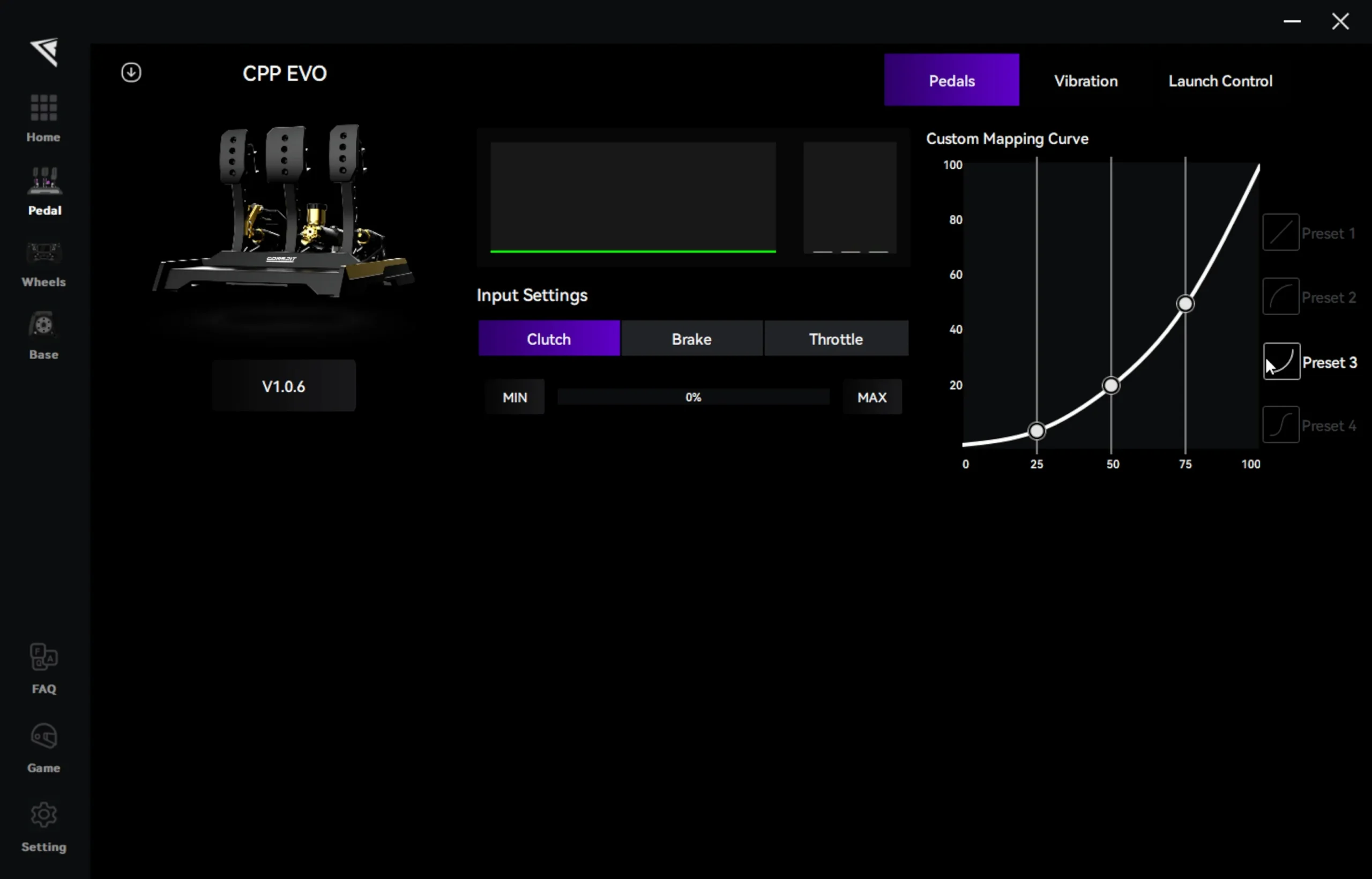
Broadly speaking, the software is clean, modern and functional. It covers the core things most people need: pedal calibration, button mapping, vibration assignment, wheel settings, profile switching and wheelbase tuning.
One feature we did like was the inclusion of UDP forwarding. That is useful for anyone running multiple telemetry-based applications, because it helps avoid conflicts when software like SimHub and manufacturer software both need access to the same game data.
Where the software became less convincing for us was around tuning depth. Some of the more advanced wheelbase settings appear to have been simplified or removed, and the result is a software experience that feels like it is pushing users toward presets rather than offering truly deep control.
That may make the platform more approachable for some people, but for us it felt limiting, and we struggled to fine tune the force feedback in a meaningful way.
There were also smaller quirks, such as paddle calibration inconsistencies on some wheels that required recalibration after booting the system, as well as inconsistent SimHub compatibility across the wheel range.
So overall, the software is competent, but it did not strike us as a major strength of the ecosystem.
Conclusion
After spending a long time testing a broad range of CONSPIT hardware, the overall picture is both promising and a little frustrating.
There is clearly a lot to like here. CONSPIT has done a very good job of building an ecosystem that looks modern, offers plenty of features, remains relatively open, and comes in at pricing that is more accessible than a lot of alternatives with similar headline specifications. The steering wheels in particular were a real highlight, with strong ergonomics, good feature sets, and in the case of the MAX 01 especially, a genuinely impressive balance of quality, usability and value.
But once you get past that strong first impression, the experience becomes more mixed.
The ARES wheelbases have capable underlying hardware and plenty of potential, but they did not feel fully refined in the way the force feedback was delivered, and the software currently does not offer the depth of tuning we would like to see to really work around that. The CPP EVO pedals have a strong feature set on paper, but some of the design decisions and details around the brake and clutch left us with more questions than confidence. The quick release system is also one of the clearest weak points in the ecosystem at this stage, with too much variation and play across the samples we tested.
That does not mean CONSPIT is missing the mark entirely. Far from it. In fact, what makes this ecosystem interesting is that so many of the foundations are actually quite good. The product direction makes sense, the openness of the ecosystem is appealing, and there are parts of the range that are already genuinely competitive.
The issue is that, right now, CONSPIT still feels like a brand with strong ideas that has not yet matched them with the same level of consistency and refinement across the board.
So where do we land?
If your priority is getting a lot of features, a lot of visual appeal and a lot of flexibility for the money, CONSPIT is absolutely worth a look, particularly if the steering wheels are what drew you in. But if you are chasing the most refined, polished and confidence-inspiring ownership experience possible, there are still enough rough edges here that we would be approaching the ecosystem with some caution.
At this point, CONSPIT feels less like a finished ecosystem leader and more like a brand with a lot of potential, some genuinely strong products, and some very obvious areas that still need work.
Sim RACING
Discount Codes
Pros
- Strong visual design across the ecosystem
- Aggressive pricing relative to the feature set
- Open ecosystem with good third-party compatibility options
- Steering wheels standout, with strong ergonomics and feature sets
- Quick release pricing and ecosystem expansion costs are relatively accessible
Cons
- Wheelbase force feedback lacks the refinement and consistency of the best alternatives
- Software tuning depth feels limited, especially for wheelbase fine tuning
- Quick release system showed too much variation and play across samples
- Brake preload warning raises concerns about long-term consistency
- CPP EVO brake tray showed noticeable flex under heavier braking
- SimHub compatibility is inconsistent across the wheel lineup


Related Articles

CONSPIT Sim Racing Hardware Review
Is CONSPIT OVERHYPED? ARES 20 Platinum, ARES 12, CPP EVO Pedals & Wheels Tested CONSPIT has exploded in popularity recently with a formula that on

VNM Direct Drive Wheelbase Review
VNM HAS QUIETLY BUILT ONE OF THE MOST INTERESTING DIRECT DRIVE LINEUPS IN SIM RACING — AND IT’S NOT JUST ABOUT TORQUE. The range now

Fanatec Podium DD Wheelbase – Detailed Review
The Fanatec Podium DD enters the high-end direct drive wheel base market at a time when competition has never been fiercer. What was once a

Moza R25 Ultra Direct Drive Wheel Base – Detailed Review
Even More Strength Than The R21 Ultra, but is it complete overkill? Moza’s new R21 Ultra and R25 Ultra arrive in an increasingly crowded part

Moza R21 Ultra Direct Drive Wheel Base – Detailed Review
More Strength for the Money Than Anything Else, But Does 21Nm of torque Actually Make the MOZA R21 Ultra a Better Wheelbase? Moza’s new R21

Logitech G RS50 Direct Drive Wheelbase – Detailed Review
The RS50 is Logitech’s first serious alternative to the Fanatec GT DD Pro for PlayStation users in this price category.—and offers a superior driving experience
MORE REVIEWS and Discounts


If these Sim Racing Reviews have helped you find the best racing simulator gear for your sim rig, please consider using the affiliate links on this website. By purchasing through these links, a small commission will come back to Boosted Media at no additional cost to you. This is how Boosted Media keeps providing content to the Sim Racing community.