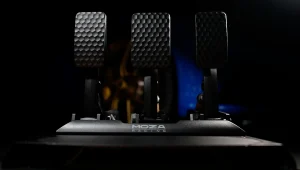
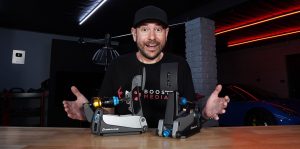
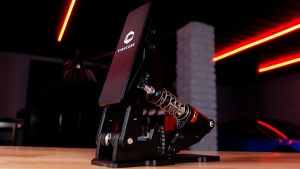
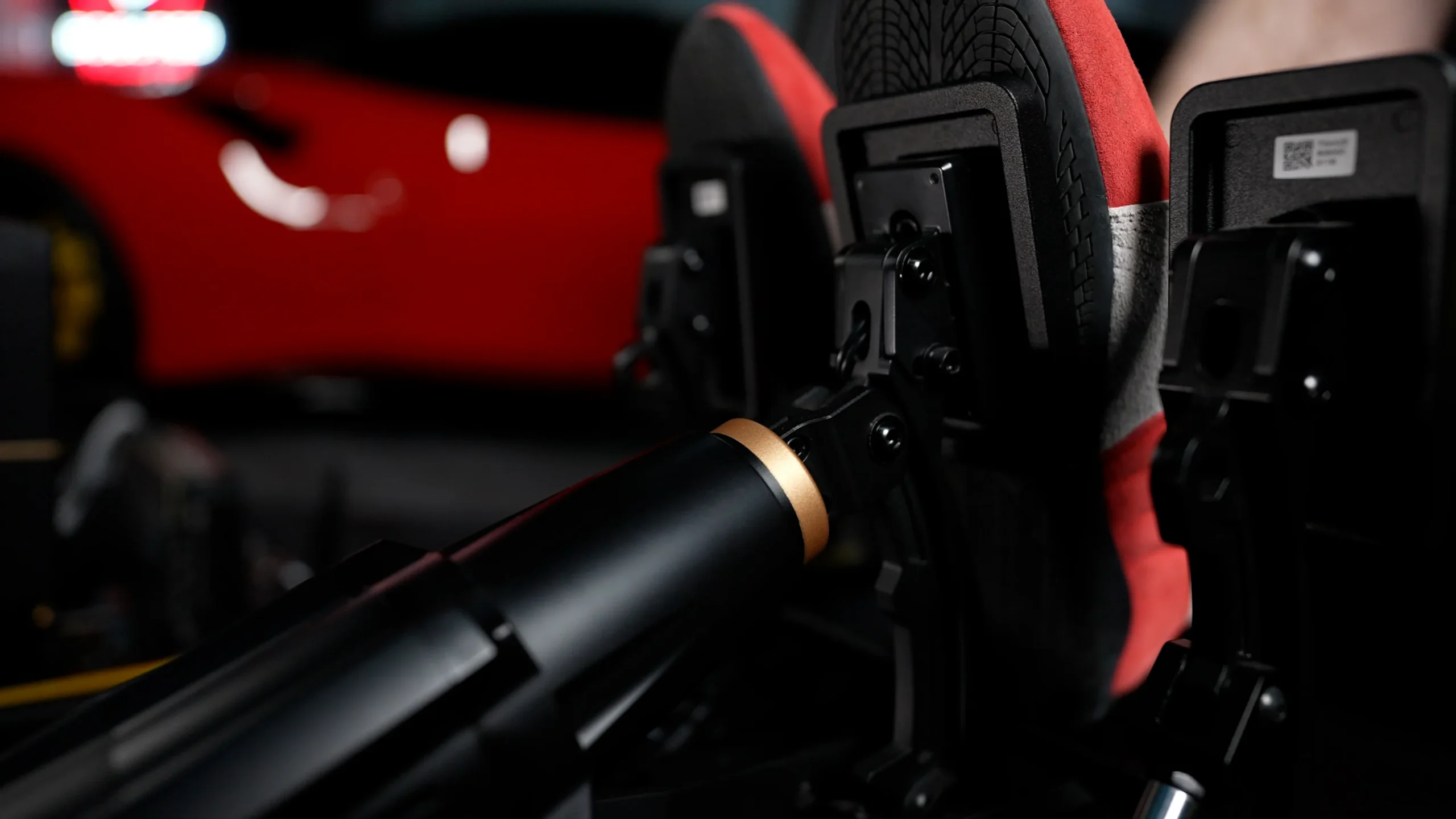
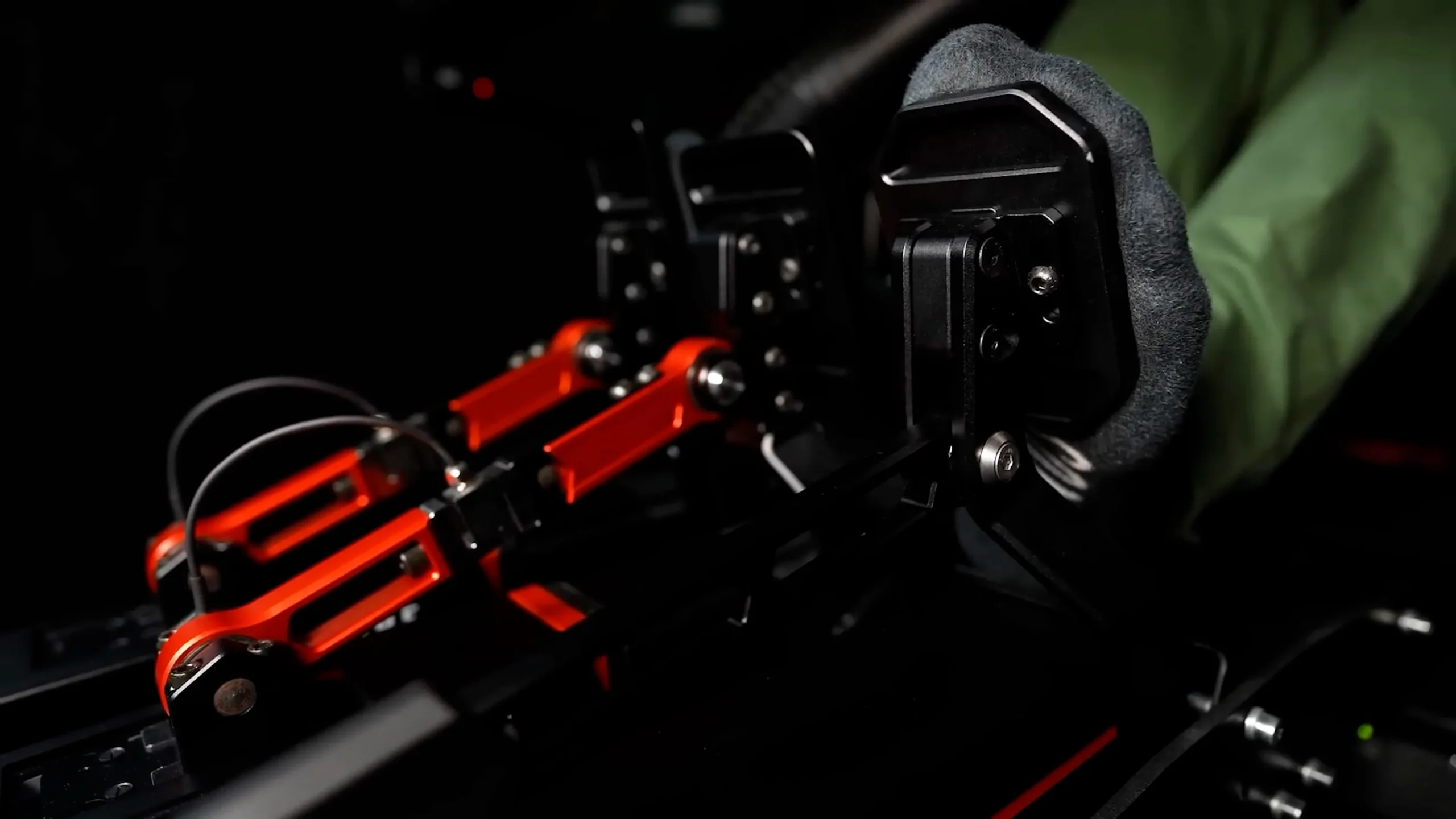
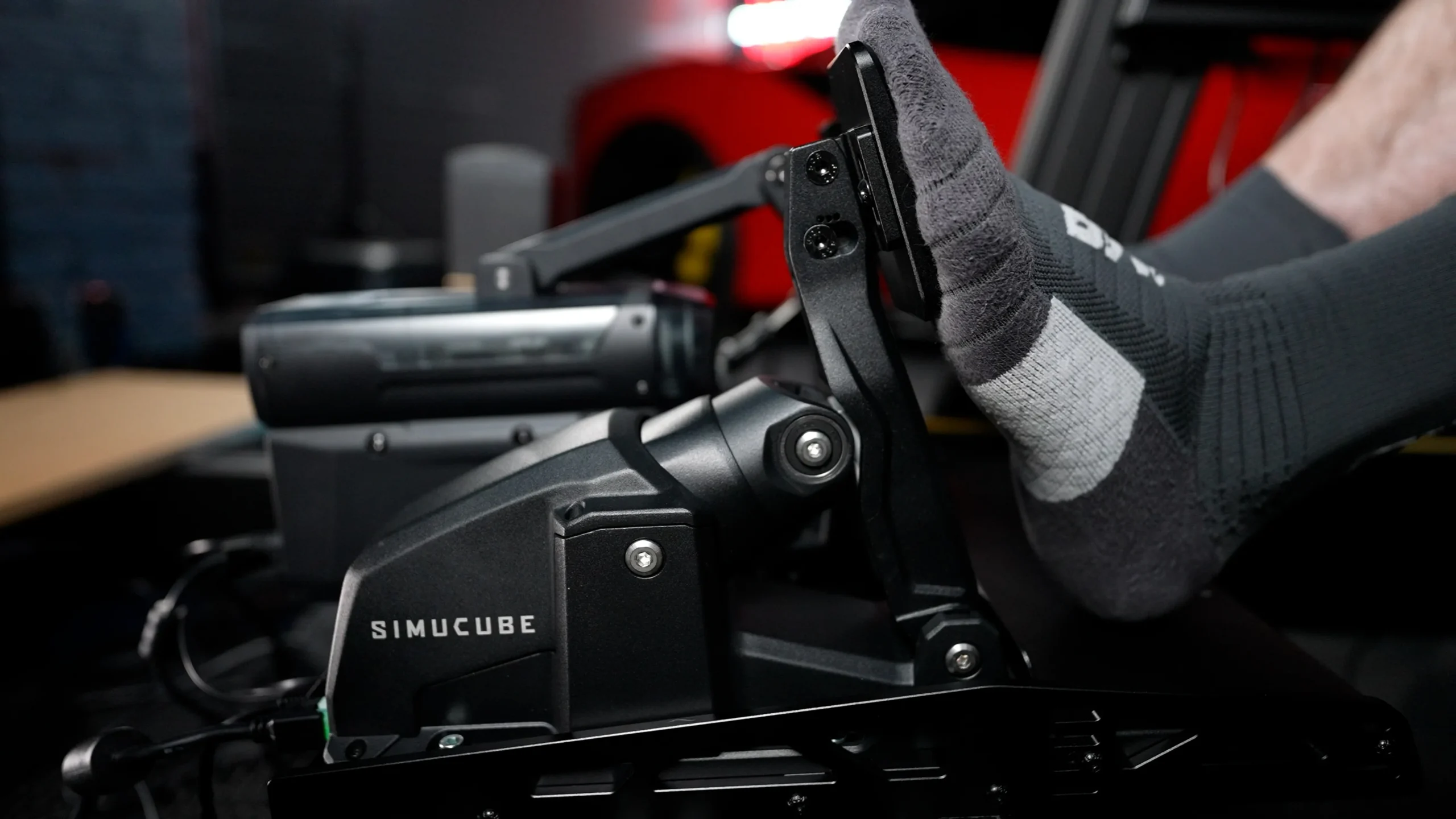
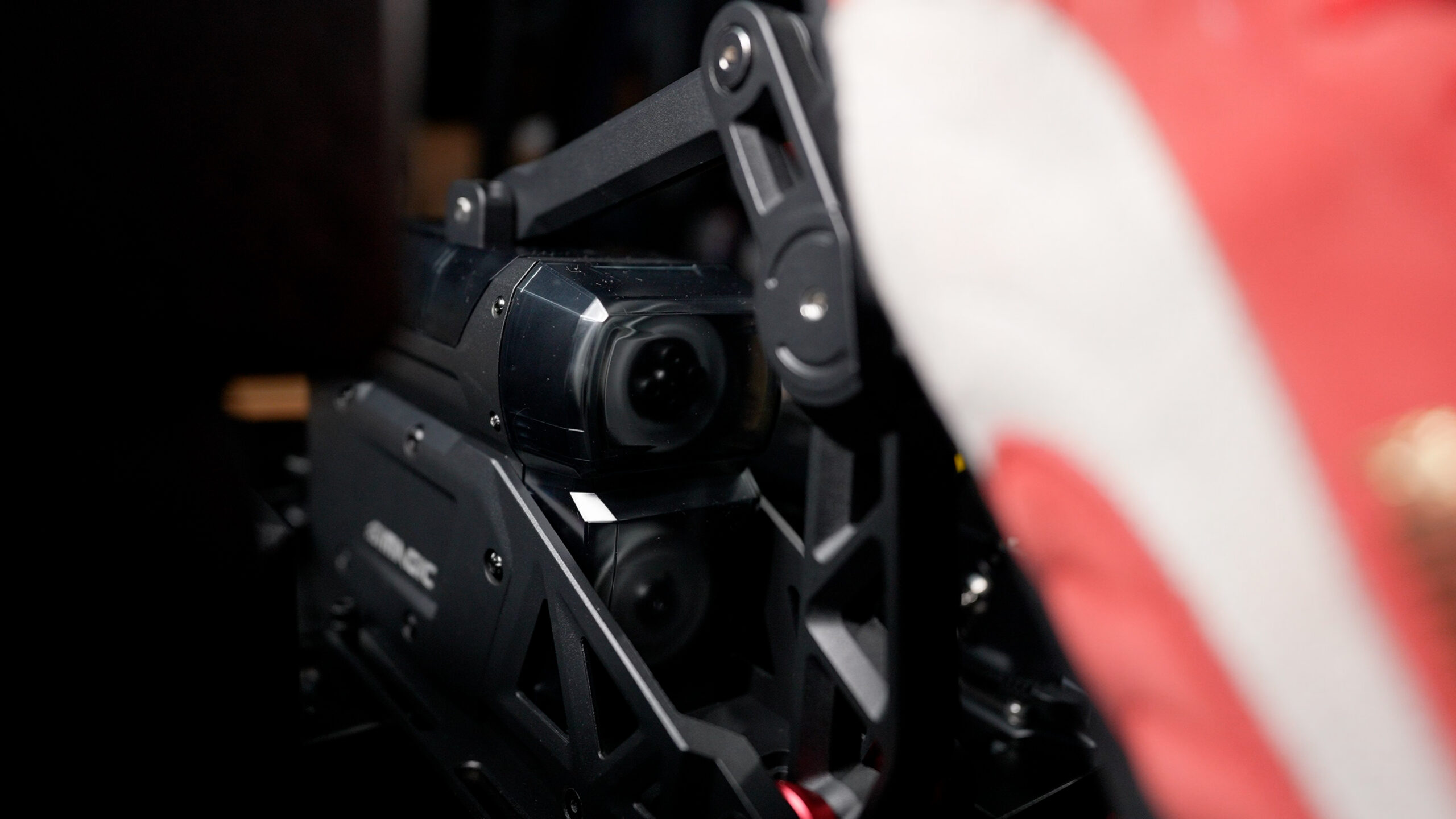
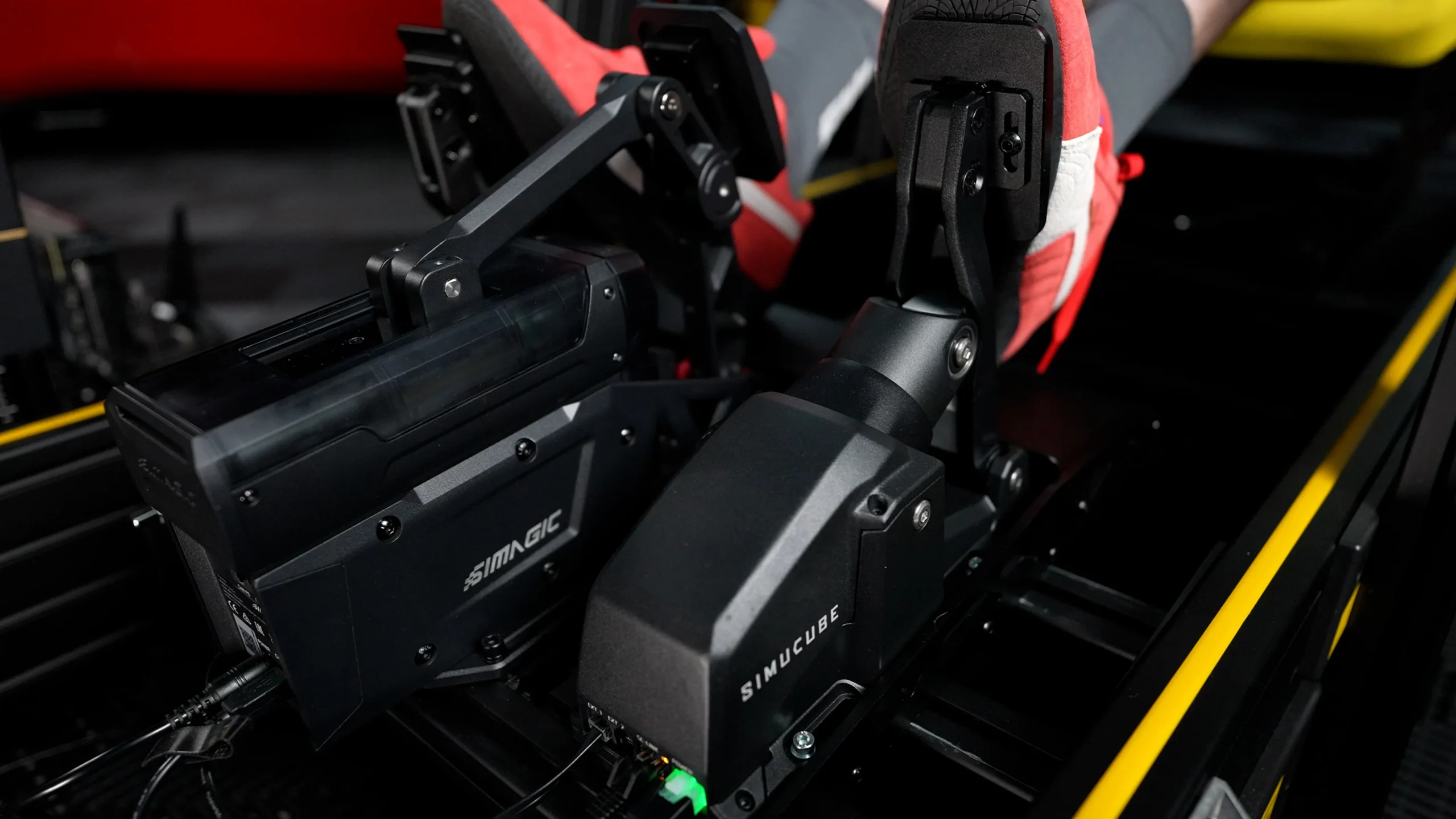
The Simagic P-Active is the smoothest active pedal we’ve tested, smoother even than Simucube’s ActivePedal Pro and Ultimate.
For a long time there was no real competition in active pedals worth talking about. That has changed with two new releases: the Simagic P-Active and the Simucube ActivePedal Sport. I tested both back to back against the MOZA mBooster, with Simucube’s ActivePedal Pro and Ultimate as the benchmark.
The Quick Verdict
Best overall: Simagic P-Active
US$999. Smoother overall feel and effects on par with Simucube, for a much lower price.
3% OFF with Discount Code: BOOSTED
Best value: MOZA mBooster
US$759 on sale (US$799 regular). Around 90% of the Simucube experience for roughly half the cost.
3% OFF with Discount Code: BOOSTED
Money no object: Simucube ActivePedal Ultimate
€2,398.80 incl. VAT. 170 kg of force and a five-year warranty.
3% OFF with Discount Code: BOOSTED
Hard to justify now: Simucube ActivePedal Pro
€1,682.40 incl. VAT, plus Link Hub. Still excellent, but the P-Active is smoother for far less.
Disappointing: Simucube ActivePedal Sport
€901 excl. VAT, plus Link Hub. The grainiest active pedal I’ve tested, with a 100 kg ceiling.
Disclosure and How We Tested
Simucube, Simagic and MOZA all sent their pedals for this comparison. The ActivePedal Sport, P-Active, mBooster and ActivePedal Pro were all sent under exactly the same conditions. Simucube also sent one ActivePedal Ultimate for review when it launched, and I bought two more so I could live with them long term as a Throttle/Brake/Clutch combo.
Pedals have been tested both back to back on the same rig and for longer stints, primarily as a brake pedal to get a complete understanding of their strenghts and weaknesses.
If you buy through the links on this page, we may earn a small commission at no extra cost to you. This is a great way to support Boosted Media if our reviews and guides have helped you out.
Do You Actually Need an Active Pedal?
Only as a brake, and even then for feel rather than lap time
What an active pedal does
Every active pedal on the market works to achieve the same two things:
- Adjustable feel at the click of a button. Position, travel and how the pedal feels underfoot are set in software. You can save a rock-hard formula car brake, a long and soft road car brake, or a grabby race clutch, and switch between them without touching a tool. All five pedals here can be set up as a brake, throttle or clutch.
- Effects. The pedal can pulse when ABS kicks in, vibrate with the engine, react to traction loss, or buzz as the wheels lock in cars without ABS.
How I actually use mine
I’ve run active pedals on my daily rig for more than three years and driven a huge range of cars for our content. I could count on one hand the number of times I’ve switched profiles.
Muscle memory matters more than variety. Change the pedal feel between cars, jump back to what you were driving before, and you can easily be a second a lap slower. So I run one profile that does the job for everything.
I rarely change the throttle or clutch either. A throttle just needs to be smooth, with enough travel, and come back up quickly. Beyond that it’s personal preference.
What they still can’t do
No sim currently sends a physics-based signal to the pedal. The pedal is told something like “ABS is active”, and the software turns that into a vibration you’ve tuned. The car’s physics aren’t driving what you feel.
No sim has added brake fade through the pedal yet, even though the hardware could do it. So few people own active pedals that sim developers have had little reason to add it.
With the effects available today, a good haptic transducer gets you within about 10 to 20% of the experience. ABS feels great through an active pedal, but realistically a transducer is almost as useful.
My advice
- Brake: this is the only place I’d consider an active pedal.
- Throttle or clutch: I can’t recommend one, unless you love changing how your pedals feel between cars.
I love driving with my active pedals and I don’t regret buying them. But look at what each pedal offers and be honest about how much of it you’ll actually use before spending this kind of money.
The Contenders
From one €2,400 pedal in 2023 to five, starting under US$800
| When | Pedal | What it is |
|---|---|---|
| Late 2026 | Simagic P-Active | Simagic’s first active pedal, with a belt-driven motor |
| Late 2026 (on sale early 2027) | Simucube ActivePedal Sport | Simucube’s new entry-level and much more compact active pedal |
| March 2025 | MOZA mBooster | The first active pedal from another brand, at less than half the price of the ActivePedal Pro |
| October 2024 | Simucube ActivePedal Pro | A cheaper version of the original, which was renamed the ActivePedal Ultimate |
| June 2023 | Simucube ActivePedal (now Ultimate) | The first commercial active pedal, and our first full active pedal review |
When I reviewed the original ActivePedal in 2023, there was nothing to compare it with. I called it the best pedal I’d ever used, but also well past the point of diminishing returns. A single Ultimate still lists at €2,398.80 on Simucube’s store today, the same price it launched at.
Pricing and Value
What each pedal costs, and what else you’ll need
The MOZA mBooster is the cheapest way into an active pedal, and the Simagic P-Active costs US$240 more. Simucube’s pedals cost more again, and only the Ultimate includes the Link Hub you need to connect it to your PC.
These are the prices on each brand’s official store on 23 November 2026, in the middle of Black Friday sales, so check our price trackers before you buy.
All three brands sell through resellers around the world, and we list deals from partner resellers we’ve worked with and are happy to recommend. Once you factor in shipping, import duties and tariffs, a local reseller may work out cheaper, so shop around. Our price trackers will also catch any brand that bumps its prices up before a sale to make the discount look bigger.
Official store prices
| Pedal | Official store price | Also needed | Bundles |
|---|---|---|---|
| MOZA mBooster | US$759 on sale (US$799 regular) | Nothing, it plugs straight into your PC | mBooster Pedal Set with CRP2 Throttle: US$949 on sale (US$999 regular) |
| Simagic P-Active | US$999 | Nothing, it plugs straight into your PC. P-Active base plate optional at US$99 | P1000-FB bundle with a P1000 throttle and base plate: US$1,199 |
| Simucube ActivePedal Sport | €901 excl. VAT (US$1,199 excl. tax). Early access only, on sale early 2027 | Simucube Link Hub, unless you already own one | Sport + Co-Pedal + Link Hub: €1,280 excl. VAT (US$1,798 excl. tax) |
| Simucube ActivePedal Pro | €1,682.40 incl. VAT | Simucube Link Hub: €97.20, or €78.54 in Simucube’s Black Week sale | Pro + Co-Pedal: €2,040. Pro + Co-Pedal + base plate: €2,232 |
| Simucube ActivePedal Ultimate | €2,398.80 incl. VAT | Nothing, the Link Hub is in the box | Set of two: €4,329.72. Set of three: €6,380.58 |
A few things to watch for
- Simucube’s VAT labels don’t match. The Sport is listed excluding VAT. The Pro, Ultimate and accessories are listed with VAT included for the country you’re shopping from, so the Sport’s real price is higher than its headline figure (our check was with the store set to Austria).
- The Link Hub isn’t in the Sport or Pro box. One Link Hub runs your whole Simucube rig. If you already have one, you don’t need another.
- Running more than one Simucube Link device (two ActivePedals, or an ActivePedal with a Simucube 3 wheelbase) also means an Ethernet switch: €58.80 from Simucube, or included with the Ultimate add-on pedal.
- Simucube’s Ultimate add-on pedal (€2,158.80) is only for adding to an existing Ultimate. It comes without its own power supply or Link Hub.
- The Pro and Ultimate aren’t part of Simucube’s Black Week sale.
Hardware and Specs
Maximum force is the spec that separates them
The Sport tops out at 100 kg, half the mBooster’s 200 kg.
| Pedal | Max pedal force | Drive | Connects to your PC through | Warranty |
|---|---|---|---|---|
| MOZA mBooster | 200 kg | Servo motor and ball screw | USB, or a MOZA wheelbase | Up to 24 months |
| Simagic P-Active | 180 kg | Servo motor and screw, joined by a 1:1 belt | USB | 24 months |
| Simucube ActivePedal Ultimate | 170 kg (120 kg in medium-force mode) | Servo motor and screw | Simucube Link Hub (included) | 5 years |
| Simucube ActivePedal Pro | 110 kg | Servo motor and screw | Simucube Link Hub (sold separately) | 3 years |
| Simucube ActivePedal Sport | 100 kg | Servo motor and screw | Simucube Link Hub (sold separately) | 36 months |
Specs from the official MOZA, Simagic and Simucube product pages.
How they work
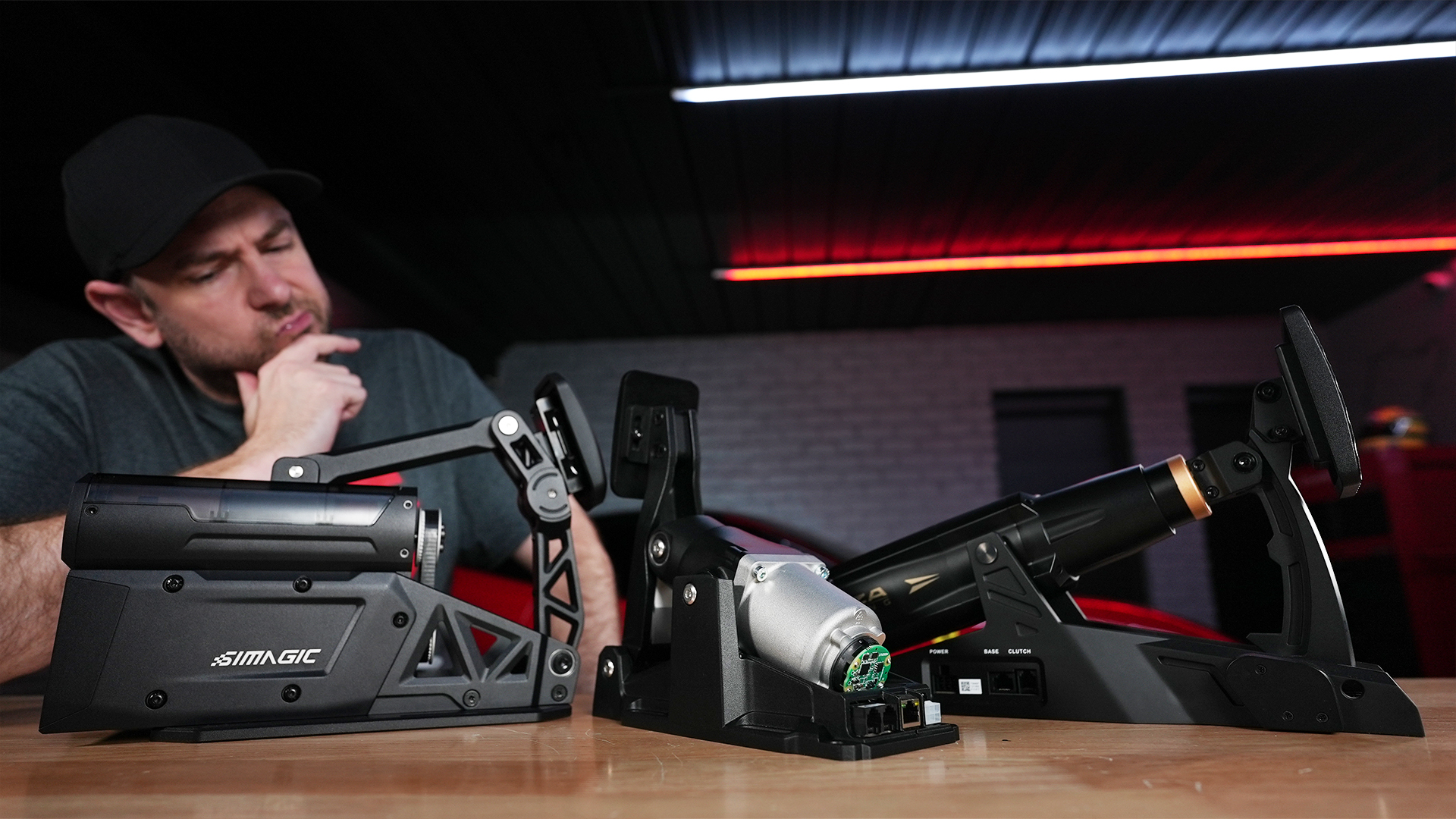
Every active pedal on the market works in fundamentally the same way. An electric motor drives a screw mechanism that winds in and out, very quickly or slowly and smoothly, and the pedal face moves with it. A load cell measures how hard you’re pushing.
Smaller pedals generally mean smaller, less powerful motors. The Sport is far more compact than the Pro and Ultimate, at 250 mm long against 418 mm and 400 mm, and its lower force is the sacrifice that comes with that.
Why Simagic’s belt drive isn’t a step backwards
Simagic took a different approach. Rather than shrinking the motor, it stacks the motor and the screw on top of each other and connects them with a belt.
I know what a lot of you are thinking: wheelbases moved from belts to direct drive, so isn’t this going backwards? But a pedal is trying to do something very different. A steering wheel needs razor-sharp detail through your hands. A brake pedal doesn’t, and most real cars still use hydraulic brakes, with natural damping from flex in the lines and the rest of the system.
The belt also runs on two pulleys of the same size, a 1:1 ratio. Belt-driven wheelbases used a smaller pulley so a cheaper motor could make more torque, at the cost of speed. A 1:1 belt isn’t trading one for the other.
The real trade-off is that a rubber belt wears, and some will eventually fail. Nobody knows yet how long that takes, and we’ll keep an eye on it. Belts have been used in industrial motors for more than a hundred years, though, so I don’t think it’s inherently bad.
Why maximum force matters more than travel
Travel isn’t worth basing a decision on. The Sport’s 60 mm was absolutely fine for me as a brake, throttle or clutch. For reference, the Pro has 74 mm and the Ultimate 62 mm (79 mm in medium-force mode), while MOZA quotes the mBooster’s travel adjustment as 0 to 25 degrees.
Maximum force is the stiffest you can set the pedal. Past it, pushing harder gives you no extra precision in your braking.
With my usual setup, I hit my threshold at about 78.8 kg on the Sport, much closer to its 100 kg ceiling than on the P-Active (180 kg) or the mBooster (200 kg). I’d consider myself a fairly heavy braker. When Misha Charoudin visited the studio earlier this year, he set my Ultimate to 120 kg, because that’s what felt right compared with the setup he prefers in the race cars he drives.
For most people, 100 kg won’t be a problem. But if you brake hard or like a very stiff pedal, the Sport (and to a lesser extent the Pro) will hold you back where the others won’t.
Build and mounting
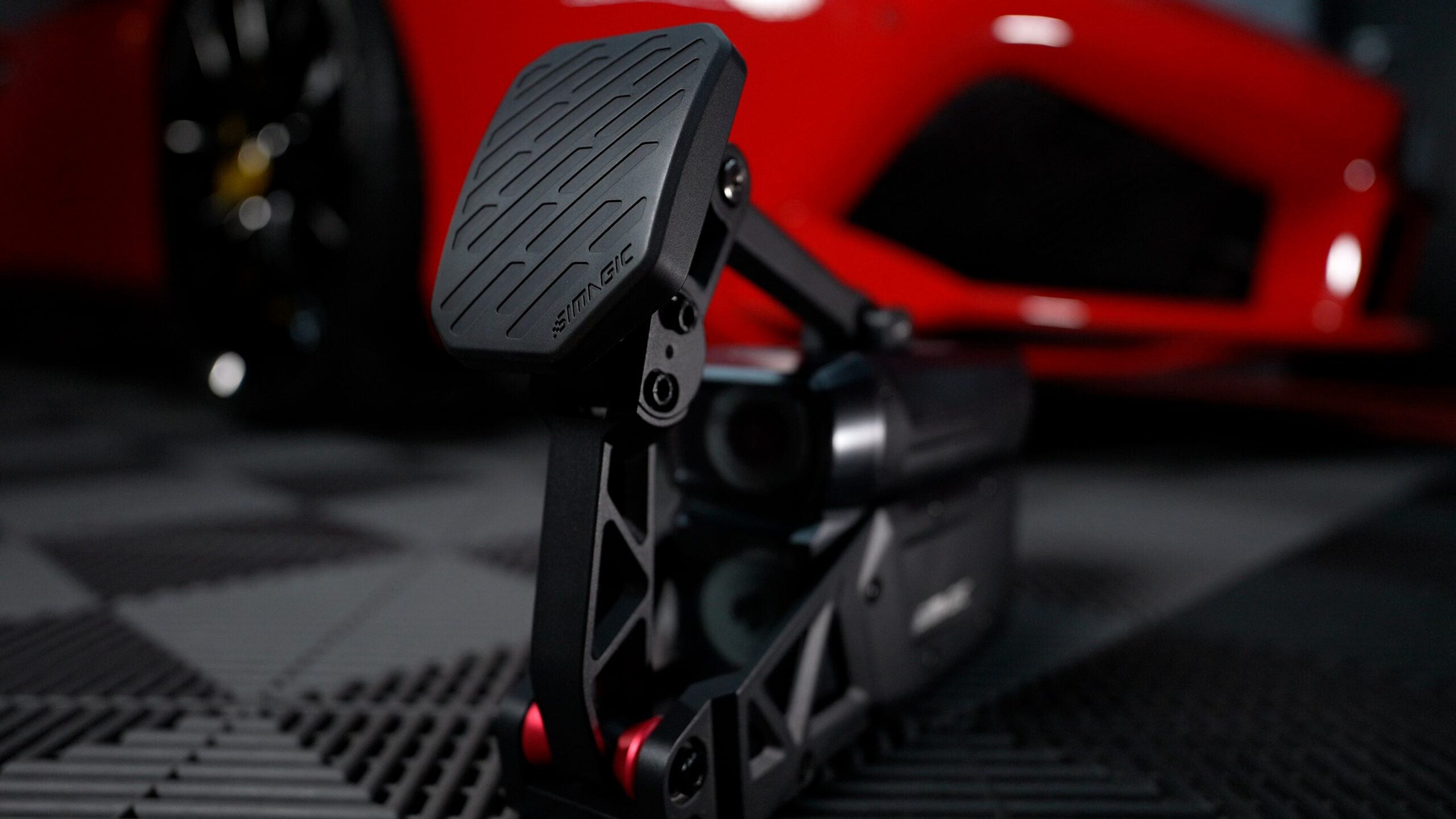
Build quality is much the same across the board: metal construction everywhere, and all of them feel equally solid. The P-Active uses more plastic, mainly as covers over the screw mechanism.
Mounting is where they differ:
- Simagic P-Active: comes with adapters for Simagic’s P1000 and P2000 pedal sets and for aluminium profile. The optional US$99 base plate is solid, but it’s essentially two pieces of thin profile with fixed front-to-back spacing, so check your other pedals’ mounting holes line up.
- MOZA mBooster: the most awkward to mount. On a CRP2 pedal tray you need MOZA’s extension plate, the mounting holes aren’t spaced in multiples of 40 mm for profile rigs, and the tray dips slightly under heavy braking.
- Simucube: the Sport mounts with four M5 slots to a standard pedal plate or rig rails. The Pro and Ultimate are long, so if your rig sits against a wall you may need to move it out. Simucube’s own base plate is €192.
The Software
Not a reason to choose one brand over another
Simagic’s SimPro Manager, MOZA’s Pit House and Simucube Tuner all do the same core job, with a few different approaches to a few features.
All three give you:
- A pedal feel curve you shape by dragging nodes, plus presets. This is the mechanical feel of the pedal under your foot.
- Input or output mapping, for how your foot’s movement translates into the sim. You can build a non-linear response like a load cell pedal’s here.
- Angle adjustment in software.
- Damping on press and release, friction and end stop feel. I keep friction off on all three.
- Profiles you can save and load.
- Telemetry effects such as ABS, wheel lock and traction control.
| Feature | Simagic SimPro Manager | MOZA Pit House | Simucube Tuner |
|---|---|---|---|
| Profile sharing | Save and load | Save and load | Save and load, plus the largest community of shared profiles |
| End stop feel | Soft, normal or firm | Sliders | Soft, normal or firm |
| ABS smoothness setting | No | Yes | Yes |
| Force feedback blending | Yes | No | No |
How I set up a brake
As I’ve said in pretty much every pedal review for five years, what matters most is a clearly defined threshold point you can hit every time. My curve starts out linear, then ramps up around that threshold, so I feel the resistance change as I press.
On both the Sport and the P-Active, I land at around 75 to 80% braking pressure consistently, with enough headroom to modulate around it.
Effects
I only run the ABS effect on a brake. All three let you set its frequency and strength.
You can also add traction control, wheel lock, wheelspin, gear shifts and engine RPM. Wheel lock is worth knowing about: in a car without ABS, the pedal pulses and pushes back as a wheel starts to lock.
Simucube and MOZA also offer a G-force effect, which moves the pedal away from you under braking, like your body being thrown forward. I don’t like it because it makes braking less consistent. In a sim rig you’re sitting fairly still, and even a motion system can’t sustain those forces. If you’re chasing maximum immersion you might love it. If you’re chasing consistency, leave it off.
Simagic’s force feedback blending
Force feedback blending is unique to Simagic. It takes certain frequencies from your wheel’s force feedback and sends them through the pedal, so you mostly feel kerbs and impacts.
It’s great to see something new, but it didn’t add anything significant for me on a brake. Any effect in the pedal changes how your foot meets it, and when you’re trail braking into a corner, that makes you less consistent. Less is more here. I was more comfortable with it on a throttle, but I can’t justify an active pedal as a throttle just for that.
Driving Experience
The P-Active is the smoothest, and the Sport the grainiest
On force feedback and effects there’s no clear winner, with MOZA a little behind the rest.
| Pedal | Smoothness underfoot | Force feedback and effects |
|---|---|---|
| Simagic P-Active | Almost hydraulic, with only a tiny bit of texture | On par with Simucube. Returns quickly when you lift off |
| Simucube ActivePedal Ultimate and Pro | A slight, constant grain. I can’t tell the two apart | The benchmark |
| MOZA mBooster | A similar grain to the Simucube pedals | About 10% behind. Slightly more robotic and less consistent |
| Simucube ActivePedal Sport | Noticeably more grain than the others | Very close to the rest |
Graininess
Every active pedal I’ve tested has a slight graininess as you push it down, something I first pointed out in my original 2023 ActivePedal review. You don’t tend to notice it while driving, but you do when you test back to back.
To be honest, the Sport has disappointed me here. Its grain never gets bad enough to bind or affect your input, but it’s clearly more pronounced than on any other active pedal I’ve tested. The P-Active surprised me the other way: there’s still a tiny bit of texture, but it’s noticeably smoother than even the Pro and Ultimate. How it sounds in our comparison clip is how it feels.
[Placeholder: embed the graininess audio comparison clip from the video]
Force feedback and effects
Between the Simagic and Simucube pedals there’s very little difference. The mBooster’s effects feel a little more robotic and erratic, and its feedback a touch vaguer, with maybe slightly more latency.
What stands out on the P-Active is how analog it feels. It almost feels like a hydraulic brake. I wondered if that might make it feel lazy when I lifted off, but it came back under my foot exactly as it needed to, with no extra latency or hysteresis. I don’t know if the smoothness is entirely down to the belt adding a little damping, but it works.
Lap times
My lap times were identical across the mBooster, Sport and P-Active, within a couple of hundredths of a second on back-to-back laps. There’s no magic cheat code here.
Simagic P-Active: Best Overall
The smoothest active pedal I’ve tested
Best for: anyone buying an active brake pedal right now, especially if you already run Simagic P1000 or P2000 pedals.
Verdict: my favourite active pedal on the market, and cheaper than any Simucube option.
Strengths
- The smoothest active pedal I’ve tested, with an almost hydraulic feel and no lag when you lift off
- Force feedback and effects on par with Simucube
- 180 kg maximum force
- Plugs straight into your PC over USB, with adapters for P1000, P2000 and aluminium profile in the box
Weaknesses
- The drive belt is a wear part, and its long-term durability is unknown
- More plastic than the others
- The optional base plate has fixed front-to-back spacing
- Force feedback blending didn’t add much on a brake
MOZA mBooster: Best Value
Around 90% of the experience for roughly half the cost
Best for: the cheapest route into an active brake, and anyone already running MOZA gear or CRP2 pedals.
Verdict: still the value pick if price matters most.
Strengths
- The cheapest active pedal here
- The highest maximum force, at 200 kg
- Around 90% of the Simucube experience as a brake, for roughly half the cost
- Dual load cells keep your braking pressure consistent wherever your foot lands on the pedal
- CRP2 throttle and clutch pedals plug straight into it, and it connects by USB or through a MOZA wheelbase
Weaknesses
- Effects about 10% behind the others, a little more robotic and less consistent
- Slightly vaguer feedback, with maybe a touch more latency
- Awkward to mount, especially on a profile rig
- When we first reviewed it, its throttle and clutch modes were broken
Simucube ActivePedal Ultimate: Money No Object
170 kg and a five-year warranty, at a premium
Best for: very heavy brakers, inverted pedal setups, and anyone who values a five-year warranty.
Verdict: I still love driving with mine, but for most people it’s overkill now.
Strengths
- 170 kg maximum force
- Five-year warranty
- Inverted mounting and an adjustable arm, and one power supply can run several pedals
- Simucube Tuner’s large community of shared profiles
- Link Hub included in the box
Weaknesses
- By far the most expensive pedal here
- The same slight graininess as the Pro, and not as smooth as the P-Active
- Long, at 400 mm
Simucube ActivePedal Pro: Hard to Justify Now
Still excellent, but out-valued by the P-Active
Best for: Simucube owners who want more force than the Sport offers.
Verdict: still an excellent pedal, but the P-Active is smoother for far less money.
Strengths
- Felt identical to the Ultimate at my settings when I compared them in 2024
- 110 kg maximum force and 74 mm of travel
- Three-year warranty
Weaknesses
- Link Hub sold separately
- A slight graininess, and not as smooth as the P-Active
- No inverted mounting or arm adjustment, and each pedal needs its own power supply
- Not part of Simucube’s Black Week sale
Simucube ActivePedal Sport: Disappointing
Compact, but grainy and capped at 100 kg
Best for: Simucube Tuner fans with little room on their rig.
Verdict: if it were your only option, the graininess wouldn’t be a deal breaker. But it isn’t your only option, and the P-Active and mBooster are better buys.
Strengths
- Very compact: 250 mm long and 3.4 kg, the shortest ActivePedal Simucube makes
- Simucube Tuner, its profile community and seven effects
- 36-month warranty
- 60 mm of travel, which was plenty for me
Weaknesses
- The grainiest active pedal I’ve tested
- 100 kg maximum force, the lowest here
- Link Hub sold separately, and not on sale until early 2027
Which Should You Buy?
For most people, the Simagic P-Active
What you already own and how hard you brake can change that.
| If you… | Buy |
|---|---|
| Want the best feel and can spend around US$1,000 | Simagic P-Active |
| Want the cheapest way into an active pedal | MOZA mBooster |
| Already run Simagic P1000 or P2000 pedals | Simagic P-Active, with adapters in the box |
| Already run MOZA gear or CRP2 pedals | MOZA mBooster, with your CRP2 throttle and clutch plugged straight into it |
| Brake very hard or want a five-year warranty | Simucube ActivePedal Ultimate |
| Are set on Simucube but can’t stretch to the Ultimate | The Pro, unless you can live with the Sport’s graininess and 100 kg ceiling |
| Mainly want ABS and other effects | A haptic transducer on your current pedals, for far less |
| Want an active throttle or clutch | Don’t. A good passive pedal with haptics does the job |
Final Verdict
The Simagic P-Active is the pick of the bunch
Given how much less it costs than Simucube’s Pro and Ultimate, that’s not what I expected to say going into this test.
The MOZA mBooster is still the value choice, if you can live with slightly less refined effects and awkward mounting. Simucube’s Ultimate remains a superb pedal for very heavy brakers, but the Pro is hard to justify now and the Sport is a disappointment.
Even as a brake, active pedals still don’t bring as much as I’d hoped by now, and that’s down to the sims rather than the manufacturers. As cheaper pedals reach more people, I hope developers finally use what this hardware can do, like brake fade.
WHERE TO BUY SIMAGIC
If our reviews helped you choose your gear, consider buying through the links on this page. We earn a small commission at no extra cost to you, and some links also come with discount codes that save you money.
Our links cover a huge range of sim racing gear, so you can support Boosted Media whatever you end up buying.
Ships from East-Sussex
Ships from Slovakia

Ships from Melbourne, AU

Ships from Global PartnersNo retailers listed for this dispatch region.
WHERE TO BUY MOZA
If our reviews helped you choose your gear, consider buying through the links on this page. We earn a small commission at no extra cost to you, and some links also come with discount codes that save you money.
Our links cover a huge range of sim racing gear, so you can support Boosted Media whatever you end up buying.
Ships from East-Sussex
Availability may vary
Ships from Slovakia
Ships from AUKLAND, NZ
Ships from Global PartnersNo retailers listed for this dispatch region.
WHERE TO BUY SIMUCUBE
If our reviews helped you choose your gear, consider buying through the links on this page. We earn a small commission at no extra cost to you, and some links also come with discount codes that save you money.
Our links cover a huge range of sim racing gear, so you can support Boosted Media whatever you end up buying.
Ships from Slovakia
Ships from Slovenia

Ships from Melbourne, AU
Ships from Global PartnersNo retailers listed for this dispatch region.
NEWSLETTER
Stay up to date with new releases And major updates
Thanks. Please check your email to confirm your subscription.
Discount Codes
Also Sells
Ascher Racing, Gomez Sim IndustriesAlso Sells
Ascher Racing, Base Performance Simulators, BDH Race Sim Hardware, ButtKicker, Cube Controls, D-BOX, Delta Sim-Tech, Gomez Sim Industries, Heusinkveld, ignitiON Controls, Max Papis Innovations, MME Motorsport, Moza, P1Sim, PlaySeat, Precision Sim Engineering, Qubic System, Simucube, Sparco, Thrustmaster, VNM Simulation, VPG SimAlso Sells
Alien Mods, Asetek, ButtKicker, CAMMUS, Conspit, Cube Controls, D-BOX, Heusinkveld, LeoXZ, Moza, Racebox, Simagic, Simnet, Unreal Racing, VNM SimulationAlso Sells
3DRAP, ANOTHER WAY, Ascher Racing, Asetek, BavarianSimTec, BDH Race Sim Hardware, ButtKicker, Conspit, Cooler Master, Cube Controls, D-BOX, Dayton Audio, Delta Sim-Tech, DOF Reality, Elgato, ESPORTSIM SRL, Fanatec, Gomez Sim Industries, Heusinkveld, HORI, KGL Creation Lab, LeoXZ, MME Motorsport, Moza, Next Level Racing, Nitro Concepts, NOVUS, O-ROUGE, P1Sim, Pimax, PlaySeat, Prosimu, PXN, Qubic System, Raslution, ResTech, Rexing, Sabelt Sim Racing, SG Racing, SIM FACTORY, Sim Racing Studio, Sim-Lab, Simagic, SIMFORGE, SIMGRADE, SimRep Engineering, SIMTRECS, Simucube, Simufy, SIMXPRO, SOELPEC, Sparco, Thrustmaster, VIRPIL, VNM Simulation, VPG Sim, VRSAlso Sells
BavarianSimTec, MME Motorsport, Qubic System, Sabelt Sim RacingAlso Sells
Ascher Racing, Asetek, BDH Race Sim Hardware, ButtKicker, Conspit, D-BOX, Dayton Audio, Fanatec, Heusinkveld, Moza, Nitro Concepts, Pimax, PlaySeat, Qubic System, Rexing, Sabelt Sim Racing, Sim-Lab, Simagic, Simucube, VNM Simulation, VPGAlso Sells
Cobra, PRO SIMRIG, Qubic System, Simagic, SparcoAlso Sells
Asetek, BJR, ButtKicker, Cube Controls, Fanatec, Moza, Next Level Racing, Thrustmaster, Turtle Beach, Qubic SystemAlso Sells
Asetek, Conspit, Cube Controls, SIMGRADEAlso Sells
BavarianSimTec, Conspit, Cooler Master, Cube Controls, DOF Reality, Moza, Pimax, Qubic System, Racebox, ResTech, Sigma Integrale Motion Systems, SimucubeAlso Sells
Conspit, Cube Controls, D-BOX, Elgato, Moza, Pimax, PlaySeat, Sigma Integrale Motion Systems, Simagic, SimucubeRelated Articles

MOZA CRP2 – Load Cell Sim Racing Pedals
The MOZA CRP2 Load Cell Sim Racing pedals are a much needed update to their predecessors. As the MOZA ecosystem has expanded and continued to

Simagic P1000 – Detailed Review
In this detailed review of the Simagic P1000 pedals, we take a close look at the ins and outs of what has become one of

CAMMUS LC100 – Budget Load Cell Pedal Review
Finding the best Load Cell Sim Racing Pedals for your needs and budget can be quite overwhelming, with a huge range of options available to

Turtle Beach VelocityOne Race – Detailed Review
Turtle Beach are well-established within the gaming industry, with their headsets found across major retailers throughout the world. They also sell a selection of Flight

Sim-Lab XP1 – Load Cell Pedal Review
You’ve likely heard of Sim-Lab as one of the leading brands for Sim Racing cockpits. But they now have a few Sim Racing peripherals available

Simucube Throttle Review
Previously on Boosted Media we took a detailed look and shared our experience with the Simucube ActivePedals. While the ActivePedals proved to be very cool when
MORE REVIEWS and Discounts
If these Sim Racing Reviews have helped you find the best racing simulator gear for your sim rig, please consider using the affiliate links on this website. By purchasing through these links, a small commission will come back to Boosted Media at no additional cost to you. This is how Boosted Media keeps providing content to the Sim Racing community.
About The Author
-
Tom Ford operates Boosted Media with his brother Will and produces all Boosted Media sim racing videos and written articles. A true motorsport fanatic with a professional background in engineering and media, he works closely with Will across testing and analysis, turning extensive product evaluations into clear, practical reviews and buying advice for sim racers.